
Florida Justice Reform Institute
  • Home
  • About
    • Mission
    • Meet the President
  • Legislative
    • On The Front Line
    • Achievements
    • 2026 Legislation
  • Appellate Work
  • FJRI in the News
  • Get Involved
    • Become a Member
    • The Committee for Florida Justice Reform
    • Contact
  • Click to open the search input field Click to open the search input field Search
  • Menu Menu
Florida Justice Reform Institute

Lawsuits Over Vaccine Ads Backed

January 20, 2026/in News Service of Florida
News Service Florida

By Jim Saunders – Jan 20, 2026

TALLAHASSEE — With supporters pointing to diminished “public trust” in vaccines and the health-care system, a Senate committee Tuesday approved a bill that would allow people injured by vaccines to sue drug manufacturers that advertise the products.

The Senate Regulated Industries Committee voted 5-3 to approve the bill (SB 408), which drew opposition from business and health-care groups.

Bill sponsor Erin Grall, R-Vero Beach, said childhood vaccination rates have decreased and that she thinks it is a “trust issue.” She pointed to difficulty in holding vaccine manufacturers accountable for problems.

“We must build back public trust when it comes to this,” Grall said.

But opponents said federal laws prevent the state from addressing such issues and that Grall’s proposal could violate the First Amendment. A federal law passed in the 1980s, for example, provides a system for people to be compensated if they are injured by vaccines — and is designed to help keep such disputes out of court.

William Large, president of the business-backed Florida Justice Reform Institute, described the federal law as creating a “no fault” system that is financed through excise taxes on vaccines.

George Feijoo, a lobbyist for the U.S. Chamber of Commerce Institute for Legal Reform, argued that Grall’s bill would increase costs, describing it as a “hidden tort tax on health care.”

Grall, who said Texas has passed a similar measure, said the bill doesn’t focus on vaccine design defects — an issue that would be trumped, or “preempted,” by federal law. She said it is focused on “advertising conduct that is leading people to have this distrust in the industry and leading to harmful results and causing injuries there is not compensation for.”

The bill would allow lawsuits in state courts and make manufacturers liable “if the manufacturer advertises a vaccine in this state and the advertised vaccine causes harm or injury to an individual.”

Among organizations opposing the bill were the Florida Chamber of Commerce, Associated Industries of Florida, the Florida Osteopathic Medical Association and the Florida Association of Family Physicians.

Grall disputed that the bill would violate First Amendment rights.

“The pharmaceutical companies can educate doctors,” Grall said. “They can put materials within the doctors’ offices. They can help consumers understand what the vaccine is and what might happen if they get the vaccine.”

The bill comes amid widespread debate about vaccines, including Florida health officials looking to do away with certain vaccination mandates for schoolchildren. U.S. Department of Health and Human Services Secretary Robert F. Kennedy Jr., a longtime vaccine skeptic, has fueled controversy about vaccinations — with many physicians and health groups pushing back by touting the importance of vaccines in preventing the spread of diseases.

Senate Regulated Industries Chairwoman Jennifer Bradley, R-Fleming Island, said Tuesday that people hear ads from pharmaceutical companies “claiming their vaccines are safe and incentivizing people to use them and they (people) have no redress, and they know that. And it creates an atmosphere of distrust.”

Bradley said the bill “is not pro-vaccine or anti-vaccine.”

“We can put our head in the sand, but public trust in our health system is weak right now,” she said.

https://www.newsserviceflorida.com/latest/headlines/lawsuits-over-vaccine-ads-backed/article_5d4b0bc4-97fa-4a98-95a8-3ef91f6cccf8.html
https://www.fljustice.org/wp-content/uploads/2024/11/fjri-news.jpg 800 800 Becky Lannon https://www.fljustice.org/wp-content/uploads/2024/11/Florida-Justice-Reform-Institute.jpg Becky Lannon2026-01-20 09:52:542026-01-22 09:53:03Lawsuits Over Vaccine Ads Backed
Florida Justice Reform Institute

Tanenbaum Tapped for Supreme Court

January 14, 2026/in News Service of Florida
News Service Florida

By Dara Kam – January 14, 2026

TALLAHASSEE — Gov. Ron DeSantis on Wednesday appointed Adam Tanenbaum, a 1st District Court of Appeal judge, to the Florida Supreme Court.

Tanenbaum, a former general counsel for the Florida House who was tapped by the governor to serve on the Tallahassee-based appeals court in 2019, will replace former Justice Charles Canady, who stepped down to join the University of Florida as director of the Hamilton School for Classical and Civic Education.

During his two terms as governor, DeSantis has chosen six of the seven current justices — and two other justices who were later tapped by President Donald Trump to serve on the 11th U.S. Circuit Court of Appeals.

Tanenbaum’s appointment cements DeSantis’ legacy of reshaping the court with conservative justices who have reversed years of precedent established by more left-leaning justices on issues such as the death penalty and abortion rights.

Tanenbaum, one of six finalists selected by the Florida Supreme Court Judicial Nominating Commission to succeed Canady, has the “courage” and “warrior spirit” to make tough decisions “regardless of the blowback,” DeSantis said during Wednesday’s announcement at Seminole High School, where Tanenbaum graduated at the top of his class in 1989.

“He has the intangibles of being somebody who is really going to fight for what is right. He’ll fight for the Constitution and fight for the people, even when it’s not easy,” the governor said.

Tanenbaum said he “wholeheartedly” embraced DeSantis’ vision for the court and praised the governor for “boldly and relentlessly pursuing a vision for a state judiciary that respects the rule of law and the separation of powers … reflects and respects the values shared by Florida citizens … and understands its place in the constellation of sovereign powers set out in the Florida Constitution.”

Tanenbaum was active in student government and Florida Blue Key as an undergraduate at the University of Florida, graduated from Georgetown University Law Center and held a variety of positions in state government and private practice before joining the appellate court in 2019. From 2016 to 2019, Tanenbaum served as House general counsel under former Speaker Richard Corcoran, who is now the president of New College of Florida, and former Speaker José Oliva.

Laying out his textualist judicial philosophy on Wednesday, Tanenbaum said he subscribes to “the fixation thesis and the constraint principle.”

“The meaning of a text is fixed at the time of its ratification or enactment, and that original meaning does not change over time,” he added.

Tanenbaum also defended the court’s duty to revisit earlier decisions.

“Our goal as judges is always to find the correct original meaning of the law. To instead follow and replicate erroneous interpretations of the past is essentially to make the law, usurping in the process the Legislature’s and the people’s authority. If we as judges profess to apply the law and not make it, then the imperative at all times is to recognize what the law is,” Tanenbaum said.

Underlying that approach “is the concept of judicial humility, not judicial supremacy,” Tanenbaum added.

“What the judges say about the law is not the law. It is merely evidence of the law. We as judges do not declare the law for the state. We seek to find the objectively true meaning of the law,” Tanenbaum said.

The newly appointed justice also said judges “constantly must be studying” the nation’s history, custom and tradition when scrutinizing laws.

“If, in the process, we discover through additional evidence that our predecessors have missed the mark, we are duty-bound to say so and seek to correct the deviation. If we come across a demonstrably erroneous interpretation of the text, as (U.S. Supreme Court) Justice (Clarence) Thomas says, we should not follow it,” he said.

Tanenbaum also pledged “to stay true to the vigorous, mission-based jurisprudential approach I’ve taken for the past six years as a district court of appeal judge, and I pledge to work tirelessly to pour everything I have into promoting the rule of law, fostering the judiciary’s respect for the separation of powers, preserving our current Constitution, and seeing to it alongside my soon-to-be colleagues, that Florida’s judiciary becomes a national model for excellence.”

Based on the Florida Supreme Court’s current composition, the person appointed to replace Canady must be a resident of Florida’s Second Appellate District at the time of appointment. The district includes DeSoto, Hillsborough, Manatee, Pasco, Pinellas and Sarasota counties.

Tanenbaum has been part of the Tallahassee-based appeals court, but his roots are in the Tampa Bay region, where he held a number of legal posts before joining the Florida attorney general’s office in 2014.

“Seminole is where I grew up, and I’m thrilled to be living here again,” Tanenbaum said.

William Large, president of the business-backed Florida Justice Reform Institute, called Tanenbaum “an exceptional choice” for the Supreme Court.

“Governor DeSantis continues to show bold and consistent leadership in reshaping Florida’s court system more so than any previous governor. Throughout his term, Governor DeSantis has appointed judges and justices who embrace textualism, and the notion that our courts should interpret our laws, not write them,” Large said in a statement.

The governor, an attorney, pointed to his imprint on the state’s high court, noting that appointing six of the seven current justices “will have been appointed by yours truly, so that’s, uh, pretty good,” especially because some governors do not have an opportunity to appoint anyone to the Supreme Court.

“These cases come up and you’ve got to render a judgment, and you have to be willing to apply the law as it’s written, and apply the Constitution as it’s properly understood. You don’t have license to change the Constitution or to change statutes because you don’t like them,” DeSantis said. “Pretty much anybody who believes in in that traditional understanding of the role of the courts would say that the appointees I’ve had have improved the court, and improved their product, and certainly the predictability, and you don’t have these things happening like we did in the past, and so, so that’s really, really good.”

— News Service Assignment Manager Tom Urban contributed to this report.

https://www.newsserviceflorida.com/latest/headlines/tanenbaum-tapped-for-supreme-court/article_bd19802f-bdaf-4e12-acfc-af789c68bb00.html?utm_source=newsserviceflorida.com&utm_campaign=%2Flatest%2Fheadlines%2Ftanenbaum-tapped-for-supreme-court%2Farticle-bd19802f-bdaf-4e12-acfc-af789c68bb00.html%3Fmode%3Demail%26-dc%3D1768420621&utm_medium=auto%20alert%20email&utm_content=read%20more 

https://www.fljustice.org/wp-content/uploads/2024/11/fjri-news.jpg 800 800 Becky Lannon https://www.fljustice.org/wp-content/uploads/2024/11/Florida-Justice-Reform-Institute.jpg Becky Lannon2026-01-14 15:17:432026-01-14 15:17:43Tanenbaum Tapped for Supreme Court
Florida Justice Reform Institute

Sides Collide on Medical Malpractice Issue

March 18, 2025/in News Service of Florida

News Service Florida

March 18, 2025 – Jim Saunders

TALLAHASSEE — On one side are people telling heart-wrenching stories about the deaths of their adult children or parents. On the other are people warning about shortages of doctors and soaring medical-malpractice insurance costs.

The two sides are colliding in the Florida Legislature, where a Senate committee Tuesday approved a bill that would change a decades-old law and clear the way for more malpractice lawsuits over patient deaths.

“The bill is about accountability, the value of life and ensuring our laws are just,” bill sponsor Clay Yarborough, R-Jacksonville, said moments before the Senate Health and Human Services Appropriations Committee voted 8-2 to approve the measure (SB 734).

But Sen. Gayle Harrell, a Stuart Republican who joined Sen. Colleen Burton, R-Lakeland, in voting against the bill, said “there are other ways to solve this problem without creating more problems in the system.” She and other opponents contend that high insurance costs drive doctors away from the state.

“We are desperately in need of physicians,” Harrell said. “If this bill passes, we are going to have an increase in medical malpractice (insurance rates). We are already the highest in the country, and it will continue.”

Proposals to change the 1990 law have surfaced periodically, but they could have more momentum this year. Yarborough’s bill has been approved by two committees, while a House version (HB 6017) has cleared one panel.

The bills involve wrongful-death lawsuits and what are known as “non-economic” damages for such things as pain and suffering.

They would undo part of the 1990 law that prevents people from seeking non-economic damages in certain circumstances. People who are 25 years old or older cannot seek such damages in medical-malpractice cases involving deaths of their parents. Also, parents cannot seek such damages in malpractice cases involving the deaths of their children who are 25 or older.

Numerous speakers have appeared at the Senate and House meetings to tell stories about how their parents or adult children died after medical malpractice — and an inability to pursue damages in the deaths.

Karen Aguilar said Tuesday her 87-year-old father died in January because of alleged negligence at a Pasco County hospital.

“Some argue that financial compensation cannot replace a loved one, and you’re correct,” Aguilar told senators. “But wrongful-death lawsuits are not about putting a price on a life. They are about ensuring accountability, deterring negligence and getting families a pathway to justice.”

But Andrew Bolin, an attorney who represents doctors and hospitals and spoke Tuesday on behalf of the business-backed Florida Justice Reform Institute, said clearing the way for more medical-malpractice lawsuits would worsen problems such as what he described as “OB deserts” — areas of the state that do not have obstetrical care.

“Non-profit hospitals have to stay open,” David Mica, a lobbyist for the Florida Hospital Association, told senators. “One-third of your rural hospitals in this state are operating at a negative margin.”

https://www.newsserviceflorida.com/latest/headlines/sides-collide-on-medical-malpractice-issue/article_960099e6-041b-11f0-9677-6fd3d8c339a0.html

https://www.fljustice.org/wp-content/uploads/2024/11/fjri-news.jpg 800 800 Becky Lannon https://www.fljustice.org/wp-content/uploads/2024/11/Florida-Justice-Reform-Institute.jpg Becky Lannon2025-03-18 13:57:342025-03-18 13:57:34Sides Collide on Medical Malpractice Issue
Florida Justice Reform Institute

Insurance Attorney Fee Fight Refueled

March 13, 2025/in News Service of Florida

News Service Florida

Rep. Hillary Cassel, R-Dania Beach, is sponsoring a bill to revamp a law about attorney fees in insurance disputes. Colin Hackley/File

  • By Jim Saunders – March 13, 2025

TALLAHASSEE — More than two years after the Legislature clamped down on lawsuits against property insurance companies, a House panel Thursday reopened a major debate about attorney fees when homeowners and insurers battle over claims.

The House Civil Justice & Claims Subcommittee voted 16-1 to approve a bill (HB 1551) that would revamp a 2022 law that shielded property insurers from paying customers’ attorney fees. The insurance industry argues the law has reduced costly litigation and helped revive the market after financial troubles.

But supporters of Thursday’s bill said the 2022 law was tilted too far toward insurers and led to homeowners being unable to fight companies over wrongfully denied claims.

“At some point, we as a Legislature have got to make sure that we’re standing up for the people of Florida and maybe not the insurance companies of Florida,” Rep. Michele Rayner, D-St. Petersburg, said.

Opponents of the bill, however, said the law has worked in helping attract carriers to Florida and holding down rates. They warned that the bill would undo the progress.

“Kudos to you. It (the law) is working,” Katelyn Ferry, who represented the business-backed Florida Justice Reform Institute, told the House panel. “Why are we fixing it?”

Attorney fees have long been a major battleground in insurance debates. Before the 2022 law, Florida had what is often described as a “one-way” attorney fee system for property insurance. Essentially, that meant If a policyholder successfully sued an insurer over a wrongfully denied claim, the insurer would be responsible for paying the policyholder’s attorney fees.

Supporters of the fee system said it ensured consumers would be able to go to court to challenge deep-pocketed insurers. But opponents said it provided an incentive for plaintiffs’ attorneys to flood the courts with lawsuits and drained money from the industry..

With carriers dropping large numbers of policies, increasing rates and, in some cases, going insolvent, lawmakers in 2022 eliminated the one-way fee system for property insurance. They followed in 2023 by passing legal changes that more broadly helped insurers.

The insurance industry and other supporters of eliminating one-way attorney fees, including Gov. Ron DeSantis, argue the change has helped the property insurance market bounce back.

The House bill would shift to what sponsor Hillary Cassel, R-Dania Beach, described as a “loser pays” fee system. If a policyholder sues an insurer, the judge would award attorney fees to whichever side prevails in the case.

Cassel said the approach would provide an incentive to settle disputes, while restoring “balance.”

“This bill does not bring us backward,” said Cassel, an attorney who represents consumers in cases against insurance companies. “But this bill does bring us balance. We are currently in an unbalanced, unjust system.”

The bill drew support from the groups such as the Florida Justice Association, which represents plaintiffs’ attorneys. It faced opposition from groups such as Associated Industries of Florida, the Florida Chamber of Commerce, the Florida Insurance Council and the Personal Insurance Federation of Florida, which represents national insurers.

“We believe this bill points us back in the direction of less options and a more unstable market by being less focused on the true needs of policyholders, whether they be homeowners or businesses, and more focused on the needs of the lawyers,” Associated Industries of Florida lobbyist Adam Basford said.

Rep. Susan Plasencia, R-Orlando, cast the dissenting vote Thursday. The bill would need to clear two more House panels before it could go to the full House. Sen. Jonathan Martin, R-Fort Myers, has filed a similar bill (SB 426) in the Senate.

https://www.newsserviceflorida.com/latest/headlines/insurance-attorney-fee-fight-refueled/article_4339d56c-004a-11f0-b292-9fb4add3c524.html

https://www.fljustice.org/wp-content/uploads/2024/11/fjri-news.jpg 800 800 Becky Lannon https://www.fljustice.org/wp-content/uploads/2024/11/Florida-Justice-Reform-Institute.jpg Becky Lannon2025-03-13 20:07:112025-03-13 20:07:11Insurance Attorney Fee Fight Refueled
Florida Justice Reform Institute

Medical Malpractice Caps Emerge in Senate

January 22, 2024/in News Service of Florida

News Service of FL

By Jim Saunders Jan 22, 2024

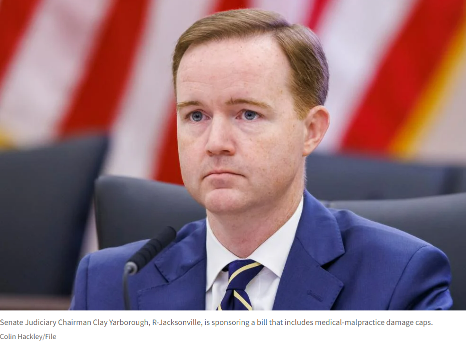
Yarborough

TALLAHASSEE — Florida senators Monday began moving forward with a proposal that would make major changes in the state’s medical-malpractice laws, including limiting pain-and-suffering damages in lawsuits against doctors and hospitals.

The proposal refueled a decades-long debate in the Capitol about damage caps, pitting doctors, hospitals, insurers and business groups against plaintiffs’ attorneys and people who said they had suffered from malpractice.

The Senate Judiciary Committee voted 8-2 to support the bill (SB 248), which initially called only for revamping another medical-malpractice law. The committee added the proposed caps to the bill.

Supporters of the caps said they are needed to hold down medical-malpractice insurance rates and help attract doctors to Florida.

“There is a malpractice crisis, no matter how you look at it,” said Charles Chase, an anesthesiologist who represented the Florida Osteopathic Medical Association at Monday’s meeting. “Florida is up at the top in almost every statistical category, malpractice.”

But opponents of the caps said they would shortchange people who have been injured or died because of the negligence of doctors and other health providers.

“There has never been any evidence that these cases are brought frivolously,” Senate Minority Leader Lauren Book, D-Davie, said. “These are a lot of times the worst of the worst.”

Under the proposed caps, a plaintiff in a personal-injury or wrongful-death case involving medical malpractice could receive a maximum of $500,000 in “non-economic damages” from doctors or practitioners, regardless of how many practitioners are liable. The cap would be $750,000 in lawsuits against hospitals or other “nonpractitioners.”

Lower caps would apply in lawsuits against doctors who provide emergency care and lawsuits involving Medicaid patients. The caps would not apply to “economic” damages, which involve such things as lost compensation.

Malpractice caps have long been a contentious issue. The Legislature in 2003 held special sessions before passing a series of caps on non-economic damages.

But the Florida Supreme Court in 2014 and 2017 rulings struck down those caps, finding that they were unconstitutional.

Senate Judiciary Chairman Clay Yarborough, R-Jacksonville, said the caps approved by the committee Monday were designed to address the Supreme Court’s concerns, including about equal-protection violations. Also, the makeup of the Supreme Court has changed dramatically since 2014 and 2017, with five of the current justices appointed by Republican Gov. Ron DeSantis.

The committee’s move Monday to tie the proposed caps to the bill about the other medical-malpractice law created an unusual dynamic.

That law prevents adult children from collecting pain-and-suffering damages in lawsuits involving the wrongful deaths of their parents. It also prevents parents from recovering the damages in the deaths of adult children over age 25.

The bill would allow adult children and parents to seek damages in such cases.

Doctors and insurers in the past have fought similar proposals. But they were willing to go along Monday when the proposed change was coupled with the overall caps on non-economic damages.

“If we are going to remove that prohibition (on pain-and-suffering damages in the adult wrongful-death cases), then we also must have some counterbalance in the system,” said Andrew Bolin, a medical-malpractice defense attorney who represented the Florida Justice Reform Institute, a group that lobbies for lawsuit limits.

Lawmakers from both parties supported the underlying bill, but Yarborough indicated that tying it to the caps was the only way to build enough support to move forward.

“This is hard,” Senate Majority Leader Ben Albritton, R-Wauchula, said. “It’s hard to strike balance.”

A House bill (HB 77) has been filed but has not been heard in committees. It does not include the proposed caps.

https://www.newsserviceflorida.com/latest/headlines/medical-malpractice-caps-emerge-in-senate/article_e8d023ae-b97a-11ee-8412-4bc5bc75a859.html 

https://www.fljustice.org/wp-content/uploads/2024/11/fjri-news.jpg 800 800 RAD Tech https://www.fljustice.org/wp-content/uploads/2024/11/Florida-Justice-Reform-Institute.jpg RAD Tech2024-01-22 15:55:282024-12-06 11:57:51Medical Malpractice Caps Emerge in Senate
Florida Justice Reform Institute

DeSantis Names Sasso to Supreme Court

May 23, 2023/in News Service of Florida

News Service of FL

By Jim Saunders – Tuesday, May 23, 2023 

TALLAHASSEE — Continuing to mold a conservative Florida Supreme Court, Gov. Ron DeSantis on Tuesday named Meredith Sasso to succeed former Justice Ricky Polston, who stepped down in March.

Sasso, of Orlando, has served as a state appeals-court judge since 2019 and is chief judge of the Lakeland-based 6th District Court of Appeal. Her previous positions included chief deputy general counsel for former Gov. Rick Scott.

With the pick, DeSantis has appointed five of the seven Supreme Court members, as the court has become dramatically more conservative since the Republican governor took office in January 2019.

“I am proud to appoint Judge Meredith Sasso to the Florida Supreme Court because her fidelity to the Constitution will help preserve freedom in our state for generations to come,” DeSantis said in a prepared statement.

Since Polston announced his resignation, speculation had swirled about Sasso as a potential successor. Along with serving in the Scott administration, she has been active in The Federalist Society, a conservative group that has played a key role in state and federal judicial appointments.

In her application for the Supreme Court seat, Sasso wrote that while working in the executive branch of government, she “gained an informed appreciation for the separation of powers.”

“Appropriate deference to coordinate branches is not a matter of courtesy; it is essential for the people’s chosen representatives to operate,” Sasso wrote. “Likewise, judicial decisions are not the only available solution to problems. When judges step outside their role, they often justify it by claiming an altruistic purpose of correcting a perceived injustice. But as judges, we should honor both our defined role and the overall system in which we operate.”

The Florida Justice Reform Institute, a legal group that advocates on issues such as limiting lawsuits against businesses, praised the appointment. William Large, the organization’s president, issued a statement that said the pick continued DeSantis’ efforts to carry out a promise to reshape the Supreme Court.

“The governor’s appointment of Meredith Sasso to the Florida Supreme Court cements this promise of appointing justices with a proven record of embracing textualism and the notion that the courts should interpret our laws, not write them.” Large said.

Sasso will join Chief Justice Carlos Muniz and Justices John Couriel, Jamie Grosshans and Renatha Francis as DeSantis appointees on the court. Justices Charles Canady and Jorge Labarga were appointed by then-Republican Gov. Charlie Crist.

Before DeSantis took office, the Supreme Court had a generally liberal majority — much to the frustration of state Republican leaders and business groups. But three longtime justices, Barbara Pariente, R. Fred Lewis and Peggy Quince, left the court in early 2019 because of a mandatory retirement age, allowing DeSantis to make appointments.

Polston, another Crist appointee, was usually part of a conservative majority, so it is unclear how much Sasso will affect the ideology of the court. Labarga is the only remaining justice from the more-liberal previous majority.

After Polston announced his resignation, three candidates, including Sasso, initially applied to succeed him. But the Florida Supreme Court Judicial Nominating Commission extended a deadline and drew 15 applicants.

The commission forwarded the names of six finalists to DeSantis. In addition to Sasso, the finalists were 6th District Court of Appeal Judges Joshua Mize, Jared Smith and John Stargel, Hillsborough County Circuit Judge Thomas Palermo and 20th Judicial Circuit Chief Judge Thomas McHugh.

Sasso became a judge on the 5th District Court of Appeal in 2019 and shifted to the newly created 6th District Court of Appeal this year after a reorganization of the appellate-court system.

In her application, Sasso gave examples of opinions she had written, including a 2020 opinion about the dismissal of a former church employee that Sasso described as testing “the reach of secular judicial power.” Sasso’s opinion rejected a lawsuit alleging breach of an employment agreement, finding that what is known as the “ecclesiastical abstention doctrine” left the issue to church authorities.

“The case is significant because it demonstrates that a secular court’s only legitimate role in resolving disputes related to religious doctrine is to ensure those disputes are committed to religious authorities,” Sasso wrote in a description of the case.

Sasso has ties to Grosshans, who also served on the 5th District Court of Appeal before being appointed to the Supreme Court in 2020. Sasso spoke at a Supreme Court investiture ceremony for Grosshans in 2021, according to Sasso’s application.

Sasso, who grew up in Tallahassee, received bachelor’s and law degrees from the University of Florida. Her paternal grandparents left Cuba in 1953, according to the application.

After stepping down from the Supreme Court, Polston became general counsel of the state-backed Citizens Property Insurance Corp. He had served on the Supreme Court since 2008.

https://www.newsserviceflorida.com/latest/headlines/desantis-names-sasso-to-supreme-court/article_92ef354e-f98e-11ed-8406-2fad1024610a.html?utm_source=newsserviceflorida.com&utm_campaign=%2Flatest%2Fheadlines%2Fdesantis-names-sasso-to-supreme-court%2Farticle-92ef354e-f98e-11ed-8406-2fad1024610a.html%3Fmode%3Demail%26-dc%3D1684863062&utm_medium=auto%20alert%20email&utm_content=headline 

https://www.fljustice.org/wp-content/uploads/2024/11/fjri-news.jpg 800 800 RAD Tech https://www.fljustice.org/wp-content/uploads/2024/11/Florida-Justice-Reform-Institute.jpg RAD Tech2023-05-23 15:55:152024-12-05 15:43:39DeSantis Names Sasso to Supreme Court
Florida Justice Reform Institute

Contractors Challenge New Insurance Law

May 31, 2022/in News Service of Florida


News Service of FL

Contractors Challenge New Insurance Law

By Jim Saunders – May 31, 2022

TALLAHASSEE — Less than a week after Florida lawmakers rushed to make property-insurance changes, a contractors group Tuesday filed a constitutional challenge that targets a new restriction on attorney fees in lawsuits against insurance companies.

The Restoration Association of Florida and Air Quality Assessors, LLC, an Orlando firm that does work such as mold testing and leak detection, filed the lawsuit in Leon County circuit court.

It came after lawmakers last week passed a measure (SB 2-D) to try to bolster a troubled property-insurance market that has led to homeowners losing coverage and seeing spiraling premiums. Lawmakers gave final approval to the bill on Wednesday, and Gov. Ron DeSantis signed it on Thursday.

Insurers have long blamed litigation and attorney fees for driving up costs. The new law took a series of steps to try to address those issues, but the constitutional challenge focuses on part of the measure that deals with what is known as “assignment of benefits.”

In assignment of benefits, homeowners sign over their insurance claims to contractors, who then seek payment from insurance companies — often spurring lawsuits about claims and payments.

Contractors in the past have been able to recover their attorney fees from insurers if they are successful in the lawsuits, a concept known as “prevailing party fees.” But the new law stripped contractors of being able to recover prevailing-party fees when they are assigned benefits.

Homeowners can still recover prevailing-party fees if they file lawsuits directly against insurers, but the contractors cannot. The lawsuit alleges that the change violates equal-protection and due-process rights and denies contractors access to courts.

“Claims submitted to insurers for work performed by contractors under an AOB (assignment of benefit) are generally not large in monetary amount,” the lawsuit said. “When the insurer delays, underpays or does not pay a claim at all, contractors are forced to commence an action against the insurer to recover the full amount due for the work performed. Without the corresponding right to recover prevailing party fees, SB 2-D makes it economically unfeasible for the contractor to pursue its lawful rights and remedies in court.

Invoices for work performed by contractors under AOBs are generally not significant enough for a lawyer to agree to represent the contractor on a contingency fee basis and it is not economically reasonable for the contractor to … pay a lawyer on an hourly basis to recover the amount(s) owed.”

The lawsuit said invoices for work done by Air Quality Assessors and many other members of the association often total $2,500 to $3,000.

“The inability to recover prevailing party attorneys’ fees will effectively shut the courthouse door to plaintiffs because it will be cost-prohibitive to pay an attorney for these types of small claims,” the lawsuit said.

But William Large, president of the Florida Justice Reform Institute, a business-backed group that lobbies to reduce litigation, said in a statement after the law passed that “property insurance lawsuits have exploded over the last several years, overwhelming Florida’s insurance market.”

“Senate Bill 2-D contains significant litigation reforms and gets to the heart of escalating rates and limited coverage — lawsuit abuse,” Large said.

Assignment of benefits has long been a contentious issue in the insurance industry. The Legislature in 2019 put additional restrictions on assignment of benefits, at least in part because of an increase in residential water-damage claims.

But contractors contend that assignment of benefits helps homeowners who are unfamiliar with making sure insurance claims are handled properly.

“AOBs are not new and have been used for a long time, especially during emergency weather situations,” the lawsuit said. “In Florida, AOBs are prevalent in the residential property context when homeowners suffer damage to their home and need to hire contractors to repair the issues.”

The lawsuit, which includes seeking a preliminary injunction against the law, names as defendants Melanie Griffin, secretary of the state Department of Business and Professional Regulation, and Donald Shaw, executive director of the Construction Industry Licensing Board. The case has been assigned to Leon County Circuit Judge Layne Smith, according to an online docket.

https://www.newsserviceflorida.com/latest/headlines/contractors-challenge-new-insurance-law/article_3a444532-e12b-11ec-bc02-9b78be19d779.html#tncms-source=login 

https://www.fljustice.org/wp-content/uploads/2024/11/fjri-news.jpg 800 800 RAD Tech https://www.fljustice.org/wp-content/uploads/2024/11/Florida-Justice-Reform-Institute.jpg RAD Tech2022-05-31 15:53:302024-11-24 22:40:38Contractors Challenge New Insurance Law
Florida Justice Reform Institute

Supreme Court Shields Top Executives from Depositions

August 26, 2021/in News Service of Florida

News Service of FL

Supreme Court Shields Top Executives from Depositions

By Jim Saunders – Aug 26, 2021

TALLAHASSEE — Prompted by a case involving the retired chairman of Suzuki Motor Corp., the Florida Supreme Court on Thursday shielded high-ranking business executives from having to give depositions in lawsuits.

Justices, in a 6-1 decision, extended to corporate executives a protection that has long allowed top government officials to avoid being required to testify about government actions. The decision said broadening what is known as the “apex doctrine” will help prevent harassment of corporate leaders.

“Over the years, varied government officers in Florida have benefited from the apex doctrine,” said the 15-page decision, written by Justice Carlos Muniz and joined by Chief Justice Charles Canady and Justices Alan Lawson, Ricky Polston, John Couriel and Jamie Grosshans. “We think that the efficiency and anti-harassment principles animating that doctrine are equally compelling in the private sphere.”

Muniz wrote that the decision is not a “blanket prohibition” on high-ranking corporate executives facing depositions. In part, declarations or affidavits will have to be filed that indicate the executives lack “unique, personal knowledge of the issues being litigated.”

But in a dissent, Justice Jorge Labarga wrote that the majority decision “abandons Florida’s longstanding refusal of affording special discovery protections to top-level corporate decision-makers.” He also argued that Florida already had adequate legal rules to prevent potential harassment.

“Florida’s existing discovery framework provides trial courts with the necessary tools to address abusive discovery practices, ranging from mandating the method of discovery to be used, to prohibiting the discovery from occurring in the first place. … Accordingly, there is no need for the special discovery protection afforded to top-level corporate officers by the majority’s new rule,” Labarga wrote.

Muniz wrote that the “impetus” for the Supreme Court to address the issue was a dispute about whether Osamu Suzuki, who retired in June as the chairman of Suzuki Motor Corp., should have to be deposed in a Florida products-liability lawsuit.

That lawsuit was filed against the Suzuki company by Scott Winckler, who was paralyzed from the waist down in a 2013 motorcycle accident, according to an appellate court ruling. Four months after the accident, the company issued a recall of the brakes on the type of motorcycle Winckler was riding, and the lawsuit related to the brakes issue.

In the lawsuit, Winckler’s attorneys argued that the Suzuki chairman had knowledge about facts relevant to the case and should testify. But the company’s attorneys fought efforts to depose the chairman, arguing in part that the plaintiff’s attorneys could get the information from lower-level company officials.

A divided panel of the 1st District Court of Appeal in 2019 rejected an attempt to prevent Osamu Suzuki from testifying, saying the apex doctrine had not been extended to high-ranking corporate executives.

“The problem with its (Suzuki’s) argument is that the doctrine is only clearly established in Florida in the government context, with respect to high-ranking government officials,” appeals court Judge Timothy Osterhaus wrote in a majority opinion joined by Judge Lori Rowe.

That spurred Suzuki’s attorneys, including former Justice Raoul Cantero, to appeal to the Supreme Court. In a brief filed last year, the attorneys wrote that Osamu Suzuki’s only involvement in the brake issue had been initialing a document.

“Mr. Suzuki is the chairman of a global company,” the brief said. “His extensive duties consume his schedule. The notion that he has any personal knowledge about a motorcycle accident in Florida is not credible on its face, and plaintiff does not claim that he does.”

The Supreme Court heard arguments in December in the Suzuki case but had not ruled. Along with the decision Thursday to expand the apex doctrine, it issued an order saying it would not rule in the Suzuki case.

The Suzuki case drew friend-of-the-court briefs from a series of business and legal groups, including the Florida Justice Reform Institute, the U.S. Chamber of Commerce and the Florida Defense Lawyers Association.

William Large, president of the business-backed Florida Justice Reform Institute, issued a statement Thursday praising the court’s broader decision on the apex doctrine.

“In our amicus (brief), we argued that allowing the deposition of an apex corporate employee who does not have unique information could lead to a flood of discovery demands for that same employee in other cases, leaving that person no time to actually run the business,” Large said. “The (Supreme) Court agreed, but in an unexpectedly profound way.”

https://www.newsserviceflorida.com/latest/headlines/supreme-court-shields-top-executives-from-depositions/article_00994f34-06ad-11ec-8b4b-8baa9a85e105.html 

https://www.fljustice.org/wp-content/uploads/2024/11/fjri-news.jpg 800 800 RAD Tech https://www.fljustice.org/wp-content/uploads/2024/11/Florida-Justice-Reform-Institute.jpg RAD Tech2021-08-26 15:52:352025-09-18 13:59:01Supreme Court Shields Top Executives from Depositions
Florida Justice Reform Institute

HOUSE, SENATE DIVERGE ON HEALTH LAWSUIT BILLS

February 8, 2021/in News Service of Florida


News Service of FL

HOUSE, SENATE DIVERGE ON HEALTH LAWSUIT BILLS       

2/8/2021 Christine Sexton

TALLAHASSEE — Lawmakers are poised this year to pass legislation to protect health-care providers and other types of businesses from lawsuits related to COVID-19.

But while the House and Senate unveiled identical bills for non-health care businesses, their proposals aren’t the same when it comes to legal protections for long-term care providers, hospitals, physicians and other parts of the health-care industry.

Chief among the differences are how long legal protections should be in effect, types of COVID-19-related lawsuits that would be limited and whether to require physician affidavits when lawsuits are filed. 

A proposed bill (PCB HHS 21-01) the House unveiled Friday would make changes in how lawsuits are filed, including requiring the physician affidavits, but would rescind the changes “one year and one day” after they become effective.

By contrast, the Senate proposal (SB 74), filed by Senate Judiciary Chairman Jeff Brandes, R-St. Petersburg, would apply to COVID-19 lawsuits for injuries that occur up to one year after the end of a declared state or federal public health emergency, whichever is later.

The chambers also take different approaches to the types of COVID-19-related claims that would be limited.

The House bill would apply to medical claims filed against nursing homes and assisted living facilities, as well medical-malpractice claims. It also would apply to COVID-19 negligence cases that could be filed against numerous other types of health-care providers, from physicians to federally qualified health centers to pharmacies and clinical laboratories.

The Senate bill, by contrast, defines COVID-19 lawsuits as claims, “whether pled as negligence, breach of contract or otherwise,” alleging that health-care providers failed to follow clinical or government-issued health standards or guidance related to COVID-19; failed to properly interpret or apply the standards or guidance in providing health care, allocation of scarce resources, or assistance with daily living; or failed to follow government-issued health standards or guidance relating to infectious diseases if there were no applicable standards and guidance specific to COVID-19.

In another difference, the House proposal would lead to judges deciding whether defendants made a “good faith effort to substantially comply with any authoritative or controlling government-issued health standards or guidance at the time the cause of action accrued.” If judges determine such good-faith efforts were made, defendants would be immune from liability. 

Despite the differences, health care lobbyists were quick to praise the House and Senate for the proposals.

“Lawsuits are not the remedy to ensuring high quality care — they simply divert precious resources away from our care centers and send a dangerous message to the health care heroes on the front lines —  that the clinical, life-saving decisions they made to protect residents will be used against them,” Emmett Reed, president and chief executive officer of the Florida Health Care Association, said in a prepared statement after the release of the House proposal.

Reed’s association, the state’s largest nursing-home industry group, issued similar praise when Brandes filed his bill.

Lawmakers will start the 2021 legislative session March 2, and lawsuit limits for health-care providers and other types of businesses are a top priority for Republican leaders.

Chris Nuland , a Jacksonville attorney and lobbyist for physician groups,  said both the House and Senate bills take steps to  protect “health care heroes” from lawsuits stemming from the pandemic, which has killed 27,815 Florida residents, according to the latest state data.

Nuland praised the House’s proposal for specific inclusion of medical malpractice claims.

“This is an excellent piece of legislation. Should this pass, the health care providers who risked their lives treating patients, or were told they could not legally treat patients, would not be punished for doing the right thing,” Nuland said in a statement to The News Service of Florida.

There are some changes, however, physician associations would like to see in the House proposal.

“Ideally, the bill would not sunset in one year, as we have no idea how long this pandemic will last,” Nuland said of one of the potential changes to the measure.

Health care providers have been calling for protections from COVID-19-related lawsuits for nearly a year. The Florida Medical Association, the Florida Osteopathic Medical Association and the Florida Justice Reform Institute in March 2020 requested that Gov. Ron DeSantis issue an executive order protecting physicians from medical-malpractice lawsuits for care provided during the pandemic.

Hospitals and nursing homes quickly followed suit, sending a letter to the governor on April 3 asking for immunity from civil and criminal liability for “any harm or damages alleged to have been sustained as a result of an act or omission in the course of arranging for or providing health care services” during the pandemic. 

Under the House’s proposal a plaintiff couldn’t file a  COVID-19 lawsuit against a health care provider without first getting an affidavit from a state-licensed physician attesting that the claim was the result of the defendant’s actions. The Senate bill does not have such a requirement.

The affidavit requirement in the House bill is identical to one in the bills that would shield other types of businesses from COVID-19 liability. Those bills (HB 7 and SB 72) are being fast-tracked through legislative committees, but the affidavit requirement has drawn objections from House and Senate Democrats.

Florida Justice Reform Institute President William Large said the affidavit requirement mirrors those in laws governing how medical malpractice lawsuits are filed.

“We want to make sure it’s not taken away,.” said Large, whose business-backed group lobbies on a variety of issues aimed at limiting lawsuits.

While the House and Senate bills include differences, they also have similarities. As an example, both proposals would require plaintiffs to file complaints within one year after such things as a COVID-19 illnesses or deaths occur. If such a cause of action “accrued” before the legislation takes effect, the plaintiff would have one year to file a lawsuit.

https://new.newsserviceflorida.com/app/post.html?postID=39748 

https://www.fljustice.org/wp-content/uploads/2024/11/fjri-news.jpg 800 800 RAD Tech https://www.fljustice.org/wp-content/uploads/2024/11/Florida-Justice-Reform-Institute.jpg RAD Tech2021-02-08 15:49:552024-11-25 08:36:13HOUSE, SENATE DIVERGE ON HEALTH LAWSUIT BILLS
Florida Justice Reform Institute

BUSINESS COVID-19 PROTECTIONS BACKED IN SENATE

January 25, 2021/in News Service of Florida


News Service of FL

BUSINESS COVID-19 PROTECTIONS BACKED IN SENATE

1/25/2021 – Christine Sexton                                                                                                                                                                      

TALLAHASSEE — The Senate Judiciary Committee on Monday approved a proposal that would give Florida businesses that “substantially” comply with public-health guidelines broad protection from coronavirus-related lawsuits filed by customers and employees.

The bill (SB 72) would not apply to health-care providers such as hospitals, nursing homes and physicians, who have been clamoring for protections since spring. Instead, the bill would help shield other types of businesses and educational and religious institutions from claims for damages, injuries or deaths.

The Republican-controlled committee spent more than two hours debating the bill and four amendments offered by Democrats before voting 7-4 along party lines to move it to the Senate Commerce and Tourism Committee.

“I promise all my bills will not be like this. I promise that we will work together in most of our legislation in a much more, I believe, collaborative way to address this,” said Judiciary Chairman Jeff Brandes, a St. Petersburg Republican who is sponsoring the bill.

Without the legislation, Brandes said businesses could face lawsuits if they did not “wholly” comply with the various public-health orders issued at the state, local and federal levels.

“They would have been subject to lawsuits that could have put them under. Not only businesses but homeowners against homeowners, parishioners against pastors, and I think that’s what this legislation does,” Brandes said. “It says, ‘Look, we need to create a safe harbor for those businesses that substantially complied with the guidelines.’”

The proposal’s supporters contend employers that have been struggling to remain in operation during the pandemic are at risk of getting sued. But a Senate staff analysis said only six lawsuits have been filed.

Florida Justice Reform Institute President William Large, however, said his research indicates that 53 lawsuits have been filed across the state. Large said litigation has been filed against nursing homes and cruise lines, neither of which would be protected under the bill.

Large asked senators to ensure that they consider similar legislation to protect health-care providers.

“Sometime in the future, make sure our health-care providers are included in a bill that substantially looks like this,” said Large, whose business-backed group lobbies on a wide range of issues related to limiting lawsuits.

Brandes’ bill would require plaintiffs to file claims within one year after incidents. They would be required to obtain affidavits from Florida physicians attesting that the defendants’ acts or omissions caused the damages, injuries or deaths.

Businesses that courts deem have “substantially” complied with government-issued health standards or guidance would be immune from liability. The bills also would make it harder to win lawsuits, raising the bar of proof from simple negligence to gross negligence and upping evidentiary standards from the current “greater weight of the evidence” to “clear and convincing evidence.” 

Democrats on the committee proposed amendments that were defeated or withdrawn. For example, Sen. Tina Polsky, a Boca Raton Democrat who is an attorney, filed an amendment that would have required a “qualified medical expert” to sign an affidavit that a plaintiff was positive for COVID-19 at the time the cause of action accrued and that the plaintiff’s infection resulted in injury, damages, or death.

Polsky’s amendment would have deleted the provision in the bill that would require physician affidavits. In offering her amendment, Polsky said a physician would not be qualified to determine whether a business’ actions caused the COVID-19 infection.

The Republican-led Legislature unveiled the Senate bill and its House counterpart (HB 7) this month. The bills are identical, and House and Senate leaders have thrown their support behind the proposals. The House bill cleared its first subcommittee last week in a party-line vote.

Lawmakers are considering the proposals as the numbers of COVID-19 cases and deaths have surged in Florida during the fall and winter. As of Monday, 1,658,169 cases of COVID-19 and 25,446 resident deaths had been reported in Florida since the pandemic hit.

Bill Herrle, executive director of the small-business group NFIB Florida, said businesses are keenly aware the liability proposal is moving through the Legislature.

“I can assure you that business owners are very aware that you are addressing this issue; that  you are debating it today,” Herrle said. “And the thing they like about it the most is it’s being done today here at the very outset of the legislative session.”

But Sen. Perry Thurston, a Fort Lauderdale Democrat who is an attorney, said he didn’t think liability protection was the most important COVID-19-related issue for the Legislature to tackle first as it prepares for the March 2 start of the annual session.

“Blanket immunity that we have here is not what I think should be our first line of attack on this virus that has plagued our community,” Thurston said, adding that he gets calls about food insecurity and evictions and job loss. “One of the speakers talked about the fact that this is the first item of business for the Florida Legislature. I think it’s something that we should be addressing. But when I have to go back to my community and talk about people being evicted, people having food insecurities, life or death issues, I think it’s a sad reflection on the state that this is what we choose to address first as it relates to this virus.”

https://new.newsserviceflorida.com/app/post.html?postID=39593 

https://www.fljustice.org/wp-content/uploads/2024/11/fjri-news.jpg 800 800 RAD Tech https://www.fljustice.org/wp-content/uploads/2024/11/Florida-Justice-Reform-Institute.jpg RAD Tech2021-01-25 15:49:522025-07-09 13:04:05BUSINESS COVID-19 PROTECTIONS BACKED IN SENATE
Page 1 of 41234

FJRI News Categories

FJRI News Archive

Search Search
Florida Justice Reform Institute

Florida Justice Reform Institute

  • Phone

    (850) 222-0170

  • Hours of Operation

    Monday – Friday, 9 a.m.-5 p.m.

  • Location Location
    Address

    215 South Monroe Street
    Suite 140
    Tallahassee, FL 32301

Site Links

  • The Committee for Florida Justice Reform
  • About
  • Legislative
  • Appellate Work
  • FJRI in the News
  • Get Involved
© 2026 Florida Justice Reform Institute, All Rights Reserved. | Website Hosting & Web Development by RAD TECH
  • Link to Facebook
  • Link to X
  • Link to LinkedIn
Scroll to top Scroll to top Scroll to top