
Florida Justice Reform Institute
  • Home
  • About
    • Mission
    • Meet the President
  • Legislative
    • On The Front Line
    • Achievements
    • 2026 Legislation
  • Appellate Work
  • FJRI in the News
  • Get Involved
    • Become a Member
    • The Committee for Florida Justice Reform
    • Contact
  • Click to open the search input field Click to open the search input field Search
  • Menu Menu
Florida Justice Reform Institute

Florida property insurance bill would repeal 2022 reforms that stabilized the market, insurers say

February 17, 2025/in Yahoo News

South Florida Sun Sentinel
Florida property insurance bill would repeal 2022 reforms that stabilized the market, insurers say
Ron Hurtibise, South Florida Sun Sentinel
Mon, February 17, 2025 at 5:59 PM EST
Florida property insurance bill would repeal 2022 reforms that stabilized the market, insurers say

A political titan has filed a provocative bill he says will reduce insurance costs in Florida — and the insurance industry doesn’t like his proposals.

One provision would roll back recent restrictions on fees that attorneys can collect when they sue insurers. Another provision would require insurers to publicly disclose their companies’ subsidiaries and affiliates and all of the ways their executives benefit from them.

The proposals are in similar bills filed in the state House and Senate this week. The House bill was filed by Rep. Alex Andrade, R-Pensacola.

The Senate bill was filed by Sen. Don Gaetz, R-Crestview, a longtime heavyweight in Florida politics and father of former U.S. Rep. Matt Gaetz.

Don Gaetz was reelected to the state Senate last fall after an eight-year absence. Last year, he campaigned on promises to fix an insurance system that has continued to raise costs for homeowners while saving significant money avoiding legal costs.

“Floridians pay far more for property insurance than anyone anywhere else in the nation,” the two lawmakers were quoted in a news release as saying. “Admittedly, Florida is a high-risk market, but we believe there are steps the Legislature can take to improve how rates are set and how individual claims can be processed faster and fairer.”

The release quoted Gaetz blaming high insurance prices for the slowing pace of new residents coming to Florida.

“High insurance costs make the Free State of Florida into the Unaffordable State of Florida for many seniors on fixed incomes trying to stay in their homes, young families including military families trying to buy their first homes, and businesses of every size,” Gaetz was quoted as saying.

Gaetz ran on fixing insurance

In an interview with the South Florida Sun Sentinel, Gaetz said he came out of retirement and ran for Senate last year because he had heard from Northwest Florida residents going through “serious problems” caused by “bad actors in the insurance industry.”

Despite Gaetz’s stature and name recognition, the bills’ proposals will elicit pushback among members of the House and Senate who — assuming the bills are taken up by committees — will contend that the current set of reforms enacted between 2021 and 2023 are working as intended.

“We cannot support these bills,” said Michael Carlson, president and CEO of the Personal Insurance Federation of Florida, which represents national insurance carriers and their subsidiaries.

Stacey Giulianti, chief legal officer for Boca Raton-based Florida Peninsula Insurance, said the reforms enacted from 2021 to 2023 are working and should be left as is.

“My take is that it’s not necessary, at least from the attorney fee perspective,” Giulianti said. “There are still plenty of lawyers taking cases. In fact, we still get about 100 lawsuits per month. Moreover, to go back to the old days where we paid 70% of the monies to attorneys, which was basically a cottage industry, seems completely unnecessary now that the market is stabilizing and capacity is up.”

Insurers contended that prior to the reforms, a limited but prolific group of plaintiffs attorneys figured out how to profit from a century-old Florida law that held insurance customers harmless if they sued their insurers in claims disputes and lost, but paid 100% of their legal fees if the insurer agreed to pay as little as a $1 more than their original settlement offer.

That law, called the “one-way insurance fee statute,” made way for an avalanche of frivolous lawsuits, according to insurers, that attorneys could file without exposing themselves to the possibility that they or their clients might be stuck paying insurers’ fees.

Now, a policyholder who wants to sue an insurer has to pay an attorney upfront or guarantee a percentage of any award. Attorneys who make their livings taking cases on contingency — without requiring upfront payment — are turning away cases over small damage amounts that they once eagerly accepted.

The bills would create a framework for reprising payments to plaintiffs’ attorneys. They would get 100% of their fees if an insurer agrees to settle for at least 80% more than the policyholder demands.

If the judgment falls within 20% and 80% of the demand, the plaintiff would collect an equal percentage of their attorney’s fees.

Only if the award is less than 20% would insurers be required to pay none of the plaintiff’s attorney fees.

The language also enables full recovery of attorneys fees by plaintiffs if insurers fail to comply with timelines for responding to claims or participating in mediation, if the plaintiff’s demand “is deemed reasonable by the court,” or if a court finds evidence of bad faith or abuse of the litigative process.

Those provisions, said William Large, president of the Florida Justice Reform Institute, amounts to “inserting the one-way attorneys fee provision back into law.”

While the reforms required plaintiffs to risk losing to the insurance company and paying its legal fees, the bill would again leave policyholders harmless whether they win or lose.

Gaetz acknowledges that, but counters, “This bill is going after bad actors in the insurance industry who don’t respond in a reasonable, fair and prompt fashion to legitimate claims.”

He points to the experience of a Panama City mother of two disabled sons who he had known. They lost their home in Hurricane Michael in 2018 and for more than a year was “ping-ponged back and forth between adjusters and lawyers” before her insurance company offered her 40 cents for every dollar of damage, which would have left her unable to rebuild her home, Gaetz said.

Ultimately, “she was so grateful to get 85 cents on the dollar” to settle her claim, he said.

Bill would require disclosure of subsidiaries

Another proposal in the bills would require the state to create reports disclosing to the public information that insurers currently label as trade secrets.

One would list all of an insurers’ subsidiaries, management companies, captive vendors and reinsurers that they have ownership stakes in and share common officers or directors. The report would detail the financial relationships between the entities.

Another report would detail compensation of each executive officer, including salaries, benefits, stock options, bonuses, stock buybacks and other taxable payments, along with profits and losses of each entity and highlight any compensation exceeding the industry average. It would also be required to explain effects of the compensation on insurers’ rate change requests.

Gaetz says the information would have to be used in rate setting, which he says isn’t occurring now.

He says he’s aware of insurers who move funds to management companies and consultants — “basically captive and owned vendors” — so they can appear to have much lower capital and profit levels when filing for rate increases.

“So if we find there’s excessive compensation with stock options and bonuses and perks and salaries, or if we find that the insurance company is sliding money off of their books and into other subsidiaries … we need to have an honest set of books that tells us where the premium dollars came from and how the premium dollars are used.”

But Paul Handerhan, president of the Fort Lauderdale-based Federal Association for Insurance Reform, says the Office of Insurance Regulation already requires such reports to be submitted. They just don’t post them on their website because they include proprietary information about companies’ business strategies.

“The insurance commissioner 100% is looking at every expenditure, every expense the insurance company has, even if those contracts are with affiliate or captive organizations,” Handerhan said.

A Dec. 18 story posted on the industry website Insurance Journal reported that ratings firm AM Best found that 13 Florida insurers that went insolvent since 2017 had surrendered almost all of their premiums to subsidies known as Managing General Agencies. Handerhan and other industry representatives were quoted in the story as saying that Florida insurers are so scrutinized by regulators, reinsurance and ratings firms, they had little room for diverting revenue unnecessarily.

Other proposals in the bill would:

— Increase the interest rate on insurance judgments or settlements from 4% to 8%.

— Require insurance adjusters to use electronic estimating software with price data consistent with contractor rates in a home’s geographic market. A loss adjustment report would have to be provided to policyholders within seven days of the inspection.

— Require insurers and policyholders to share equally in the cost of mediation, when invoked. Insurers can no longer delay claims disputes by asserting the right to reinspect damaged property.

Gaetz says he’s aware that the bill has its critics and might not even be heard by a committee — a decision that would lead to its defeat.

“I would expect William Large and others who speak for the insurance industry to oppose the bill. I would be surprised if they didn’t. But I expect a fierce fight.”

https://www.yahoo.com/news/florida-property-insurance-bill-repeal-225900973.html

https://www.fljustice.org/wp-content/uploads/2024/11/fjri-news.jpg 800 800 Becky Lannon https://www.fljustice.org/wp-content/uploads/2024/11/Florida-Justice-Reform-Institute.jpg Becky Lannon2025-02-17 11:42:162025-08-19 19:30:22Florida property insurance bill would repeal 2022 reforms that stabilized the market, insurers say
Florida Justice Reform Institute

The case for — and against — making it harder to sue health care facilities over COVID-19

March 4, 2021/in Yahoo News


Yahoo News

The case for — and against — making it harder to sue health care facilities over COVID-19

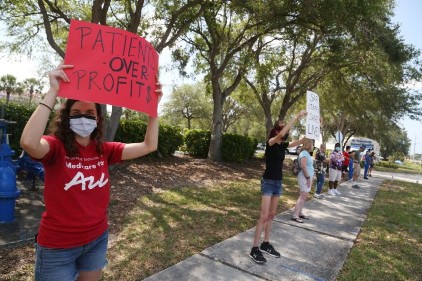
Crowd Protesting

Kirby Wilson, Tampa Bay Times
Thu, March 4, 2021, 2:53 PM·

TALLAHASSEE — One of the top Republican priorities during the legislative session would make it harder for patients and their families to sue health care providers in COVID-19-related cases.

Although destined to pass, the measures, Senate Bill 74 and House Bill 7005, have proven to be quite controversial. Detractors say it would make it harder for mistreated patients to hold nursing homes or hospitals accountable in a state with an already troubled health care system. Supporters say the state should shield health care providers — the heroes of the coronavirus pandemic — from unnecessary lawsuits.

The liability bills are not to be confused with other bills — SB 72 and HB 7 — which would protect non-health care businesses from COVID-19 lawsuits.

Let’s break down key arguments for and against the legislation.

Pro: A wave of lawsuits is coming

Civil defense attorneys have testified before lawmakers that they’re staring down dozens of coronavirus-related lawsuits. Robin Khanal, an Orlando-area attorney who advocates for long-term care facilities, has said he’s got more than 60 cases or potential cases on his desk. William Large, the president of the Florida Justice Reform Institute, said at least nine COVID-19 related lawsuits have already been filed against health care providers in Florida.

The American Tort Reform Association, which is in favor of the liability protections, estimated that Florida plaintiff attorneys had spent more than $6.6 million in advertising for COVID-19 legal services as of December.

Opponents of the bill say warnings about a potential onslaught of litigation are still speculative. But even if lawsuits are coming, many of them are likely justified, they say. This is particularly true when it comes to long-term care facilities.

Two decades ago, Florida, considered then to have one of the worst nursing home systems in the country, was swimming in lawsuits against providers. In 2001, the state enacted a slate of sweeping reforms to the long-term care industry in exchange for making it harder to sue the facilities.

Since then, patient advocates argue, care standards have slipped. The tough legal environment for plaintiffs remains, however. The liability proposals would only further stack the deck against aggrieved families and patients, they say.

“This (bill) gives a pass to nursing homes that already may have been bad,” said Jeff Johnson, the Florida director of the AARP.

Con: Liability protections as a “shield”

Adequate procedures for controlling infections. Making sure facilities were adequately staffed. Properly communicating with residents’ families. Long-term care facilities should have been good at all of the above before COVID-19 hit Florida, patient advocates argue. If they weren’t, residents fared much worse during the pandemic.

That’s not a COVID-19 problem, but under the liability protection bills, caregivers would use new legal protections to paper over past shortcomings.

“We don’t want them to hide behind this liability protection in cases of abuse and neglect,” said Olivia Babis, a public policy analyst for Disability Rights Florida.

But Jeff Brandes, R-St. Petersburg, the Senate sponsor of the liability measure, said the issues health care providers had during the pandemic had little to do with how they performed previously.

“This is a global pandemic where we had conflicting guidance. No country in the world was prepared for this,” Brandes told the Times/Herald. “This swept over us like a tsunami, and our health care providers were told to swim through it,”

Pro: Frivolous lawsuits distract care workers

Those who work in long-term health care and support the liability bills warn of distracted workers.

Dedicated employees who worked night and day during a brutal pandemic will be forced to undergo endless depositions and legal wrangling, adding to their difficult day jobs.

“Lawsuits affect every single member of the nursing team,” said Kimberly Biegasiewicz, the Chief Nursing Officer for the long-term care firm Avante Group at a recent House committee meeting. “Unnecessary lawsuits put doubt in their mind that they have not given it their all.”

Union advocates argue, however, that the liability bills are not meant to protect workers. Rather, they exist to protect the bottom lines of health care conglomerates.

Roxey Nelson, the vice president of politics and strategic campaigns at 1199 SEIU United Healthcare Workers East, noted that the long-term care industry sees significant employee turnover because of the low wages offered to front line workers. (Employees bouncing from nursing home to nursing home may have exacerbated the the spread of the disease within facilities, researchers have noted.)

“The industry used COVID to say that they were having a hard time getting (certified nursing assistants) to stay at the bedside,” Nelson said. “At the end of the day, you’re not going to get (certified nursing assistants) to stay at the bedside for $11 per hour.”

Con: This shouldn’t be a top COVID-19 priority

Supporters of the liability legislation note that Florida would hardly be the first state to enact these protections. Nearly three dozen states and the District of Columbia have enacted COVID-19 liability protections for businesses.

Those who support the law, including Gov. Ron DeSantis, point out that compared to many other states, Florida’s health care system fared well during the pandemic. Despite Florida’s large elderly population, the state’s per capita death rate ranks only 26th out of the 50 states.

Detractors of the legislation argue that Florida has little to celebrate. After a year of trauma which claimed so many lives in long-term care — more than 10,500 so far — the state has its priorities out of whack, they say. Rather than focus on systemic problems, they say, the state is protecting well-heeled health care interests. And they’re doing so with COVID-19 legislation.

“The disappointment coming out of the last year is that rather than focusing on how to address this, we’re looking for ways to forget about it, sweep it under the rug,” Johnson of the AARP said.

https://news.yahoo.com/case-against-making-harder-sue-195300284.html 

https://www.fljustice.org/wp-content/uploads/2024/11/fjri-news.jpg 800 800 RAD Tech https://www.fljustice.org/wp-content/uploads/2024/11/Florida-Justice-Reform-Institute.jpg RAD Tech2021-03-04 15:50:152024-11-25 08:11:21The case for — and against — making it harder to sue health care facilities over COVID-19
Page 2 of 212

FJRI News Categories

FJRI News Archive

Search Search
Florida Justice Reform Institute

Florida Justice Reform Institute

  • Phone

    (850) 222-0170

  • Hours of Operation

    Monday – Friday, 9 a.m.-5 p.m.

  • Location Location
    Address

    215 South Monroe Street
    Suite 140
    Tallahassee, FL 32301

Site Links

  • The Committee for Florida Justice Reform
  • About
  • Legislative
  • Appellate Work
  • FJRI in the News
  • Get Involved
© 2026 Florida Justice Reform Institute, All Rights Reserved. | Website Hosting & Web Development by RAD TECH
  • Link to Facebook
  • Link to X
  • Link to LinkedIn
Scroll to top Scroll to top Scroll to top