Florida Justice Reform Institute
  • Home
  • About
    • Mission
    • Meet the President
  • Legislative
    • On The Front Line
    • Achievements
    • 2026 Legislation
  • Appellate Work
  • FJRI in the News
  • Get Involved
    • Become a Member
    • The Committee for Florida Justice Reform
    • Contact
  • Click to open the search input field Click to open the search input field Search
  • Menu Menu
Florida Justice Reform Institute

DeSantis signals veto of House-backed bill to increase sovereign immunity payouts

June 29, 2026/in State Affairs

LEGISLATURE
DeSantis signals veto of House-backed bill to increase sovereign immunity payouts
Jim Saunders – Jun 29, 2026

In a victory for local governments — and a rebuff to the Florida House — Gov. Ron DeSantis said Monday he will veto a bill that would have led to government agencies paying more in lawsuits filed by injured people.

DeSantis said House Bill 145 would have caused more “frivolous” negligence suits. The bill sought to revamp sovereign immunity laws and increase caps on the amounts government agencies could be required to pay in such cases.

“That [current] system disincentivizes frivolous lawsuits,” DeSantis said. “When you raise the cap, you are going to generate more unmeritorious lawsuits. I have no doubt that that would happen.”

House leaders made the bill a priority during this year’s legislative session, with supporters saying the limits have remained the same since 2010 and should be increased to ensure injured people are compensated fairly.

“It just means that more citizens will be able to seek redress against their government,” House bill sponsor Fiona McFarland, R-Sarasota, said during the session. “I want you to know that today, if you or I or one of our loved ones were, God forbid, to be hit by a truck, we’d have to pay attention to whether on the side of that truck there is a corporate logo, no logo or a government seal. Depending on what that vehicle is and who is driving that vehicle, we have different access to monetary wholeness, and that doesn’t sit right with me. I don’t think it should sit right with you.”

The issue was closely watched by cities, counties, school districts and other government agencies, which expressed concerns about increased lawsuit payouts and higher insurance costs.

Under the 2010 law, agencies’ liability in negligence cases is capped at $200,000 for payments to a single person and $300,000 for multiple people involved in an incident. The bill would have increased those limits to $350,000 and $500,000, respectively.

DeSantis raised concerns Monday about increasing the caps at a time when local governments could face property tax revenue cuts under a proposed constitutional amendment. The proposed amendment, which would increase the homestead tax exemption, will appear on the November ballot.

The Florida Justice Reform Institute, a business-backed group that lobbies to curb lawsuits, said in a June 9 letter urging DeSantis to veto the bill that “now is not the time to increase sovereign immunity limits as cities and counties attempt to absorb the impacts of tax reform that will reduce their coffers.”

“Local governments cannot simultaneously be expected to absorb reduced revenue flexibility and materially greater tort exposure without consequences for budgets, services, or taxpayers,” William Large, the group’s president, wrote in the letter.

McFarland also sponsored bills in 2024 and 2025 to try to increase the caps, but those measures did not pass. She initially sought this year to increase the caps to $500,000 for payments to a single person and $1 million for multiple people involved in an incident, but the Senate proposed the $350,000 and $500,000 limits.

The House voted 108-1 to pass the final version, while the Senate approved it 36-0.

The caps can be exceeded if lawmakers pass a “claim” bill, a special type of measure that directs government agencies to pay higher amounts. But the process can take years and offers no guarantees that increased amounts will be approved.

DeSantis, who has repeatedly clashed with House leaders over the past two years, said Monday he has signed claim bills.

“If it’s capped but you were harmed more, you do the claims bill and you get paid,” he said. “People have gotten millions of dollars with that.”

https://pro.stateaffairs.com/fl/legislature/governor-desantis-rejects-bill?ref=AAAAAAAD7tEAAKk1AA

https://www.fljustice.org/wp-content/uploads/2024/11/fjri-news.jpg 800 800 Becky Lannon https://www.fljustice.org/wp-content/uploads/2024/11/Florida-Justice-Reform-Institute.jpg Becky Lannon2026-06-29 20:38:102026-07-06 20:38:22DeSantis signals veto of House-backed bill to increase sovereign immunity payouts
Florida Justice Reform Institute

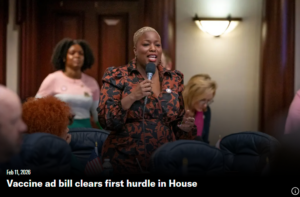
Vaccine ad bill clears first hurdle in House

February 11, 2026/in State Affairs

February 11, 2026 – Jim Saunders

Key Points

  • Florida House moves forward with vaccine lawsuit proposal
  • Bill allows people harmed by vaccines to sue drugmakers
  • Federal laws govern vaccine-related injury disputes and compensation

Amid national battles about vaccines, the Florida House is moving forward with a proposal that would allow people harmed by vaccines to sue drugmakers that advertise the products in the state.

The House Civil Justice & Claims Subcommittee voted 12-4 Wednesday to approve House Bill 339, modeled on a Texas law. Bill sponsor Monique Miller, R-Palm Bay, said it is designed to “restore trust” as vaccines have faced increased scrutiny since the COVID-19 pandemic.

“If a product is safe and effective, stand by your product,” Miller said.

But Rep. Michele Rayner, D-St. Petersburg, said the bill would create liability for drug companies based only on advertising. She said, for example, it would not require people harmed by vaccines to have seen the ads.

The bill says a drug manufacturer “is liable to an individual if the manufacturer advertises a vaccine in this state and the advertised vaccine causes harm or injury to an individual.”

“If the goal is to stop false or misleading advertising, the bill should say that,” Rayner, an attorney, said.

Debates about vaccines have increased since the pandemic, with Florida health officials last year saying they wanted to eliminate some vaccination requirements for schoolchildren. U.S. Department of Health and Human Services Secretary Robert F. Kennedy Jr., a longtime vaccine skeptic, has helped fuel the national controversy and has drawn criticism from many physicians and health groups that tout the importance of vaccines in preventing the spread of diseases.

Federal laws include processes for resolving disputes involving vaccine-related injuries. A key law is the National Childhood Vaccine Injury Act of 1986, which created a program to compensate injured people and keep disputes out of court, according to a state House analysis.

“The NCVIA significantly restricts the ability of an individual to bring a traditional liability suit by granting covered vaccine manufacturers broad immunity from liability for injuries resulting from unavoidable side effects, provided the vaccine was properly prepared and accompanied by proper directions and warnings,” the analysis said, using an acronym for the law.

William Large, president of the Florida Justice Reform Institute, an advocacy group backed by businesses, told House members that the federal laws govern disputes about vaccine-related injuries and that the bill should be rejected.

“It is preempted by three federal acts. It violates the First Amendment. It is bad public policy,” Large said.

The Senate Regulated Industries Committee approved a nearly identical proposal, Senate Bill 408, on Jan. 20. Senate sponsor Erin Grall, R-Vero Beach, said the proposal doesn’t focus on vaccine design defects — an issue that federal law would preempt.

Grall, an attorney, also disputed that the proposal would violate First Amendment rights.

“The pharmaceutical companies can educate doctors,” Grall told the Senate committee in January. “They can put materials within the doctors’ offices. They can help consumers understand what the vaccine is and what might happen if they get the vaccine.”

Rep. Kim Kendall, R-St. Augustine, said Wednesday that drug company ads should be clear and that she has heard from parents who “want to know the things they’re putting in their child’s body.”

Rep. Bruce Antone, D-Orlando, however, questioned how many people are being injured by vaccinations.

“There’s no evidence that there is a widespread problem created by vaccines,” he said.

Jim Saunders is the managing editor at State Affairs Florida. Reach him at jsaunders@stateaffairs.com or on X @JSaundersnews.

https://pro.stateaffairs.com/fl/health-care/florida-vaccine-advertising-lawsuit
https://www.fljustice.org/wp-content/uploads/2024/11/fjri-news.jpg 800 800 Becky Lannon https://www.fljustice.org/wp-content/uploads/2024/11/Florida-Justice-Reform-Institute.jpg Becky Lannon2026-02-11 11:54:322026-02-12 11:54:44Vaccine ad bill clears first hurdle in House

FJRI News Categories

FJRI News Archive

Search Search
Florida Justice Reform Institute

Florida Justice Reform Institute

  • Phone

    (850) 222-0170

  • Hours of Operation

    Monday – Friday, 9 a.m.-5 p.m.

  • Location Location
    Address

    215 South Monroe Street
    Suite 140
    Tallahassee, FL 32301

Site Links

  • The Committee for Florida Justice Reform
  • About
  • Legislative
  • Appellate Work
  • FJRI in the News
  • Get Involved
© 2026 Florida Justice Reform Institute, All Rights Reserved. | Website Hosting & Web Development by RAD TECH
  • Link to Facebook
  • Link to X
  • Link to LinkedIn
Scroll to top Scroll to top Scroll to top