
Florida Justice Reform Institute
  • Home
  • About
    • Mission
    • Meet the President
  • Legislative
    • On The Front Line
    • Achievements
    • 2026 Legislation
  • Appellate Work
  • FJRI in the News
  • Get Involved
    • Become a Member
    • The Committee for Florida Justice Reform
    • Contact
  • Click to open the search input field Click to open the search input field Search
  • Menu Menu
Florida Justice Reform Institute

House, Senate diverge on health lawsuit bills

February 9, 2021/in Florida Politics


Fla Pol

COVID gavel

House, Senate diverge on health lawsuit bills

Chief among the differences are how long legal protections should be in effect.

By News Service Of Florida on February 9, 2021

Lawmakers are poised this year to pass legislation to protect health-care providers and other types of businesses from lawsuits related to COVID-19.

But while the House and Senate unveiled identical bills for non-health care businesses, their proposals aren’t the same when it comes to legal protections for long-term care providers, hospitals, physicians and other parts of the health-care industry.

Chief among the differences are how long legal protections should be in effect, types of COVID-19-related lawsuits that would be limited and whether to require physician affidavits when lawsuits are filed.

A proposed bill (PCB HHS 21-01) the House unveiled Friday would make changes in how lawsuits are filed, including requiring the physician affidavits, but would rescind the changes “one year and one day” after they become effective.

By contrast, the Senate proposal (SB 74), filed by Senate Judiciary Chairman Jeff Brandes, a St. Petersburg Republican, would apply to COVID-19 lawsuits for injuries that occur up to one year after the end of a declared state or federal public health emergency, whichever is later.

The chambers also take different approaches to the types of COVID-19-related claims that would be limited.

The House bill would apply to medical claims filed against nursing homes and assisted living facilities, as well medical-malpractice claims. It also would apply to COVID-19 negligence cases that could be filed against numerous other types of health-care providers, from physicians to federally qualified health centers to pharmacies and clinical laboratories.

The Senate bill, by contrast, defines COVID-19 lawsuits as claims, “whether pled as negligence, breach of contract or otherwise,” alleging that health-care providers failed to follow clinical or government-issued health standards or guidance related to COVID-19; failed to properly interpret or apply the standards or guidance in providing health care, allocation of scarce resources, or assistance with daily living; or failed to follow government-issued health standards or guidance relating to infectious diseases if there were no applicable standards and guidance specific to COVID-19.

In another difference, the House proposal would lead to judges deciding whether defendants made a “good faith effort to substantially comply with any authoritative or controlling government-issued health standards or guidance at the time the cause of action accrued.” If judges determine such good-faith efforts were made, defendants would be immune from liability.

Despite the differences, health care lobbyists were quick to praise the House and Senate for the proposals.

“Lawsuits are not the remedy to ensuring high quality care — they simply divert precious resources away from our care centers and send a dangerous message to the health care heroes on the front lines — that the clinical, life-saving decisions they made to protect residents will be used against them,” Emmett Reed, president and CEO of the Florida Health Care Association, said in a prepared statement after the release of the House proposal.

Reed’s association, the state’s largest nursing-home industry group, issued similar praise when Brandes filed his bill.

Lawmakers will start the 2021 Legislative Session March 2, and lawsuit limits for health-care providers and other types of businesses are a top priority for Republican leaders.

Chris Nuland, a Jacksonville attorney and lobbyist for physician groups, said both the House and Senate bills take steps to protect “health care heroes” from lawsuits stemming from the pandemic, which has killed 27,815 Florida residents, according to the latest state data.

Nuland praised the House’s proposal for specific inclusion of medical malpractice claims.

“This is an excellent piece of legislation. Should this pass, the health care providers who risked their lives treating patients, or were told they could not legally treat patients, would not be punished for doing the right thing,” Nuland said in a statement to The News Service of Florida.

There are some changes, however, physician associations would like to see in the House proposal.

“Ideally, the bill would not sunset in one year, as we have no idea how long this pandemic will last,” Nuland said of one of the potential changes to the measure.

Health care providers have been calling for protections from COVID-19-related lawsuits for nearly a year. The Florida Medical Association, the Florida Osteopathic Medical Association and the Florida Justice Reform Institute in March 2020 requested that Gov. Ron DeSantis issue an executive order protecting physicians from medical-malpractice lawsuits for care provided during the pandemic.

Hospitals and nursing homes quickly followed suit, sending a letter to the governor on April 3 asking for immunity from civil and criminal liability for “any harm or damages alleged to have been sustained as a result of an act or omission in the course of arranging for or providing health care services” during the pandemic.

Under the House’s proposal a plaintiff couldn’t file a COVID-19 lawsuit against a health care provider without first getting an affidavit from a state-licensed physician attesting that the claim was the result of the defendant’s actions. The Senate bill does not have such a requirement.

The affidavit requirement in the House bill is identical to one in the bills that would shield other types of businesses from COVID-19 liability. Those bills (HB 7 and SB 72) are being fast-tracked through legislative committees, but the affidavit requirement has drawn objections from House and Senate Democrats.

Florida Justice Reform Institute president William Large said the affidavit requirement mirrors those in laws governing how medical malpractice lawsuits are filed.

“We want to make sure it’s not taken away,” said Large, whose business-backed group lobbies on a variety of issues aimed at limiting lawsuits.

While the House and Senate bills include differences, they also have similarities. As an example, both proposals would require plaintiffs to file complaints within one year after such things as a COVID-19 illnesses or deaths occur. If such a cause of action “accrued” before the legislation takes effect, the plaintiff would have one year to file a lawsuit.

___

Republished with permission from the News Service of Florida.

https://floridapolitics.com/archives/402147-house-senate-diverge-on-health-lawsuit-bills
https://www.fljustice.org/wp-content/uploads/2024/11/fjri-news.jpg 800 800 RAD Tech https://www.fljustice.org/wp-content/uploads/2024/11/Florida-Justice-Reform-Institute.jpg RAD Tech2021-02-09 15:50:032024-11-25 08:31:37House, Senate diverge on health lawsuit bills
Florida Justice Reform Institute

COVID-19 civil liability protection bill clears first hurdle

January 13, 2021/in Florida Politics


Fla Pol

COVID Vaccine

COVID-19 civil liability protection bill clears first hurdle
House Speaker Chris Sprowls has vowed to fast track the legislation.

By Jason Delgado on January 13, 2021

The House Civil Justice & Property Rights Subcommittee advanced legislation Wednesday that creates COVID-19 liability protections for select Florida businesses.

The bill, HB 7, cleared its first committee stop with an 11-6 vote. Republican Rep. Lawrence McClure is the bill sponsor.

By design, HB 7 shields Florida businesses, nonprofits, schools and religious institutions from frivolous COVID-19 related lawsuits.

The bill’s retroactive protections apply to organizations who make “good faith effort” to follow federal, state and local health guidelines.

Advocates contend the measure is a necessary component to Florida’s economic recovery.

“My concern is we can lose an entire generation of entrepreneurs if we don’t provide some certainty,” warned Sarasota Rep. James Buchannan.

The bill advanced without five amendments proposed by Democratic Ranking Member Ben Diamond and Rep. Yvonne Hayes Hinson. While three amendments failed and two were withdrawn, the bill underwent considerable debate.

Diamond’s amendments, among other pursuits, challenged a provision requiring a Florida physician to attest that a defendant contracted COVID-19 from the defendant’s premise.

Another amendment aimed to add employee protections into the measure. The bill — under protest by some lawmakers — remains without employee protections.

“I’m not here to say that this is more important than employee protections or other issues,” McClure said, later contending, “I want to make sure that our businesses are very comfortable reopening and operating.”

Other concerns focused on a provision mandating plaintiffs to prove with “clear and convincing evidence” that the defendant’s actions were “at least grossly negligent.”

“I think that that idea, candidly, jeopardizes the bill and I think it should come out of the bill,” Diamond suggested.

CFO Jimmy Patronis, a lead advocate for the protections, appeared before the subcommittee to speak in favor of the measure.

“Those who are working to do right by their customers and are following government guidelines should be able to operate without fear of frivolous litigation,” Patronis said. “Without actions by the Legislature, we could see more litigation raise insurance rates and hamper Florida’s recovery.”

Since Florida’s reopening, Patronis has contended that protections are needed to help Florida’s economy recover. To drive the plea home, he’s hosted “Rally at the Restaurant” tours with event stops in cities statewide. He is often accompanied by supportive GOP lawmakers and local business leaders.

Florida Justice Reform Institute (FJRI) President William Large also spoke in favor of the legislation before the subcommittee and offered some numbers.

Citing a summer study by the institute,  Large said the FJRI identified at least 53 COVID- 19 related lawsuits, though he suspects the number is  “way higher.”

The bill’s sponsor, alternatively, said he’s noted fewer than 10 lawsuits.

“Florida hasn’t faced a pandemic in over 100 years,” Large said. “Our liability laws were not built to handle something so novel and unexpected. We must modernize these laws now to avoid an explosion of costly lawsuits that threaten to keep our economy from getting back on track.

House Speaker Chris Sprowls vowed last week to prioritize HB 7. He described the bill’s advance Wednesday as a “win for small business owners.”

Florida Chamber of Commerce President and CEO Mark Wilson, meanwhile, echoed the Speaker’s sentiment in a statement.

“Today’s hearing was a step in the right direction as we aim to protect from frivolous COVID lawsuits Florida’s businesses that are doing their part to keep employees and customers safe and relaunch our economy,” Wilson said. “The business community greatly appreciates Rep. McClure’s leadership on this issue, the confidence moving this measure quickly sends to both employers and employees, and the certainty it will provide for many job creators. “

The bill will next undergo a House Health and Human Services Committee workshop on Thursday.

https://floridapolitics.com/archives/395128-covid-19-civil-liability-protection-bill-clears-first-hurdle

https://www.fljustice.org/wp-content/uploads/2024/11/fjri-news.jpg 800 800 RAD Tech https://www.fljustice.org/wp-content/uploads/2024/11/Florida-Justice-Reform-Institute.jpg RAD Tech2021-01-13 15:49:512025-07-09 13:10:22COVID-19 civil liability protection bill clears first hurdle
Florida Justice Reform Institute

Florida remains on watchdog group’s ‘watch list’ for litigation abuse

December 8, 2020/in Florida Politics


Fla Pol

ATRA Foundation

Cover art for the ATR Foundation’s Judicial Hellholes 2020/2021 report

Florida remains on watchdog group’s ‘watch list’ for litigation abuse
ATFR says Florida is out of the hellhole, but not out of the heat.

By Scott Powers on December 8, 2020

Florida is no “hellhole” for corporations and individuals hoping to avoid being targeted by excessive litigation, but it’s not out of the heat yet, according to the latest national report from American Tort Reform Foundation.

That organization is keeping Florida on its “watch list,” just above its “Judicial Hellhole” designation of municipalities, specific courts, and states that the group says are plagued by bad tort laws and “aggressive personal injury bar and fraudulent, abusive litigation practices.”

The ATRF’s annual Judicial Hellhole Report’s worst list includes the cities of Philadelphia, New York, and St. Louis, the counties of Cook [Chicago,] Madison [East St. Louis,] and St. Clair [Belleville] in Illinois, and the states California, Louisiana, Georgia, and Minnesota, along with a nod to South Carolina’s asbestos litigation.

Florida tops the next-worst tier in the ATRF’s Watch List. That list also includes Oklahoma, New Jersey, Colorado, Maryland, West Virginia, and the Montana Supreme Court.

Florida was removed from the ATRF’s Judicial Hellhole list last year. The organization credits Gov. Ron DeSantis for improving the state’s civil justice system, and for his appointments to the Florida Supreme Court, which the organization said in a news release have “reshaped the state’s judicial system and set it on a path toward becoming more balanced.

In that release, the American Tort Reform Association said it will keep its eye on Florida’s state courts and lawmakers, as bad faith laws, “no-fault” personal injury protections, and skyrocketing attorneys’ fees and other abuses continue plaguing the Sunshine State.

However, the organization said Florida still has rampant lawsuit abuse in many areas of the state – specifically in South Florida.

“Florida is one of the states hit hardest by COVID-19, and the repercussions of the virus are amplified by the legislature’s inaction in protecting small businesses and curbing lawsuit abuse,” ATRA President Tiger Joyce stated in the release. “Especially in South Florida, out-of-control legal advertising and trial attorney abuse of ‘letters of protection,’ bad faith laws, and assignment of benefits threaten to set back any progress that has been made in cleaning up Florida’s courts.”

The Florida Justice Reform Institute joined in the praise for DeSantis for addressing tort reform in Florida. In its own news release, FJRI President William Large, said DeSantis is “single-handedly pulling Florida out of its judicial hellhole.”

https://floridapolitics.com/archives/387489-florida-remains-on-watchdog-groups-watch-list-for-litigation-abuse 

https://www.fljustice.org/wp-content/uploads/2024/11/fjri-news.jpg 800 800 RAD Tech https://www.fljustice.org/wp-content/uploads/2024/11/Florida-Justice-Reform-Institute.jpg RAD Tech2020-12-08 15:52:112024-11-25 08:58:04Florida remains on watchdog group’s ‘watch list’ for litigation abuse
Florida Justice Reform Institute

Insights from Florida Chamber Insurance Summit: Liability protections needed as Session nears

November 6, 2020/in Florida Politics

Fla Pol

Virus waiter

Insights from Florida Chamber Insurance Summit: Liability protections needed as Session nears

Sen. Jeff Brandes has a bill prepped to protect businesses from lawsuits related to COVID-19.

By Renzo Downey on November 6, 2020

One legislative priority identified in the Florida Chamber of Commerce’s Insurance Summit is coronavirus liability legislation.

With Congress slow to act on COVID-19 liability protections for businesses, Gov. Ron DeSantis has said he wants the Legislature to develop its own protections for businesses.

Sen. Jeff Brandes, a St. Petersburg Republican, has legislation ready to file that would protect businesses that follow state and federal health guidelines from facing lawsuits. Similarly, his bill would protect individuals from being sued by businesses.

But Florida Justice Reform Institute President William Large told a panel at the Florida Chamber of Commerce’s Insurance Summit Friday that the state should be careful with how it tailors reforms for the business community. In recent months, other states have addressed tort reform, but Large said some states have created presumptions that “if you got COVID, you got it at work.”

“I think there’s a lesson there that if the business community tries to address some type of tort or civil liability COVID bill that it make sure that it stays in that lane and doesn’t allow it to go into the lane of creating a presumption that would create further problems,” Large said.

However, Brandes says his bill would require a physician to affirm that the plaintiff became infected at the workplace.

“Generally most other contagious diseases, people aren’t suing for,” he told Florida Politics, adding that dozens of lawsuits have already been filed in Florida. “I’ve never heard of somebody suing a company because they got the flu.”

Both Brandes and Large don’t expect coronavirus liability legislation to change insurance rates or workers compensation coverage drastically, if at all. Business interruption insurance can’t cover infectious diseases, National Association of Mutual Insurance Companies Vice President Erin Collins said during the panel.

“There is absolutely no way to create a pool where you could spread the risk sufficiently when you’re talking about something that hits everywhere, everyone, all at the same time,” she said. “It’s completely contrary and therefore uninsurable.”

While the legislation is still a work in progress, it is ready to file if the Legislature decided to hold a Special Session. Currently, there are no plans for one, and Committee Weeks begin in January ahead of the Regular Session that begins in March.

Brandes expects the bill to be passed swiftly and to apply retroactively.

DeSantis has floated liability protection legislation as one of his priorities. Congress has yet to pass liability protection legislation as Republicans’ side of the “grand bargain” after Democrats secured the monetary aid in the CARES Act, he told reporters in September.

“If you just have a store and someone (gets sick) — you cannot be held liable. First of all, how would you even prove someone was — so we’ve never done that I don’t think with any other type of virus where you can be sued, so there’s a lot of concern about liability,” DeSantis said. “I think it holds the economy back.”

A task force of state business leaders later that month released a list of recommendations, including that essential businesses should be exempt from future COVID-19-related lawsuits.

https://floridapolitics.com/archives/381804-insights-from-florida-chamber-insurance-summit-liability-protections-needed-as-session-nears 

https://www.fljustice.org/wp-content/uploads/2024/11/fjri-news.jpg 800 800 RAD Tech https://www.fljustice.org/wp-content/uploads/2024/11/Florida-Justice-Reform-Institute.jpg RAD Tech2020-11-06 15:52:072025-07-09 13:22:18Insights from Florida Chamber Insurance Summit: Liability protections needed as Session nears
Florida Justice Reform Institute

Insights from Florida Chamber Insurance Summit: Auto glass AOBs replacing property AOB market

November 5, 2020/in Florida Politics

Fla Pol

Broken Windshield

Insights from Florida Chamber Insurance Summit: Auto glass AOBs replacing property AOB market

Insurance providers want protections against malicious assignment of benefits cases.

By Renzo Downey on November 5, 2020

A year after the Legislature turned down proposed protections for auto insurance companies, speakers before the Florida Chamber of Commerce again backed the effort to create protections against possible abusive litigation.

Assignment of benefits, or AOB, allows policyholders to sign over their insurance policy benefits to a third party in exchange for quick repairs. Many times, contractors and attorneys on the other end of the AOB take insurers over inflated repair costs, goading policyholders with cash incentives to stray away from their insurers’ approved repairmen.

In 2019, Gov. Ron DeSantis signed legislation to curb AOB litigation, but House leadership carved out auto glass repair AOBs from the final product, Florida Justice Reform Institute President William Large said during his segment Thursday at the Chamber’s annual Insurance Summit. Those protections now only apply to home repairs.

Since that legislation passed, FJRI found that auto glass assignment of benefits litigation has increased in Florida. Large said people basing their businesses on AOB property claims have realized they could translate the model to auto glass claims.

“They know the game is up, and it’s moved over to AOB auto glass litigation,” Large said.

As a result, Pinnacle Actuarial Resources’ Roosevelt Mosley said insurers are facing costs for court proceedings and attorneys fees, factoring into their legal calculus. Companies have begun alerting customers to the malicious practice of profiting off attorneys fees.

“There’s really another cost that’s hidden underneath that’s really not quite as apparent, which is the cost of companies deciding not to fight the claim and simply to just pay the claim,” Roosevelt said.

Those costs will likely be shifted to policyholders’ premiums across the board.

The 2019 legislation removed the complete risk of attorneys fees from insurance companies, footing some risk now with plaintiffs. Large hoped future legislation would fill the gap for auto claims.

“We’ve seen a decline in AOB property claims,” he said. “That bill worked.”

About 40% of auto glass assignment of benefits claims have come from Hillsborough County. Another 20% come from Orange County and the next-largest share come from Broward County.

“Unless there’s been an incredible hailstorm only in Hillsborough County or a meteorite storm only in Orange County, it doesn’t make sense unless this is a business model, again, that has metastasized from AOB property litigation,” Large said.

https://floridapolitics.com/archives/381514-insights-from-florida-chamber-insurance-summit-auto-glass-aobs-replacing-property-aob-market 

https://www.fljustice.org/wp-content/uploads/2024/11/fjri-news.jpg 800 800 RAD Tech https://www.fljustice.org/wp-content/uploads/2024/11/Florida-Justice-Reform-Institute.jpg RAD Tech2020-11-05 15:52:052025-07-09 13:25:06Insights from Florida Chamber Insurance Summit: Auto glass AOBs replacing property AOB market
Florida Justice Reform Institute

Group offers proposal for liability protections

September 24, 2020/in Florida Politics


Fla Pol

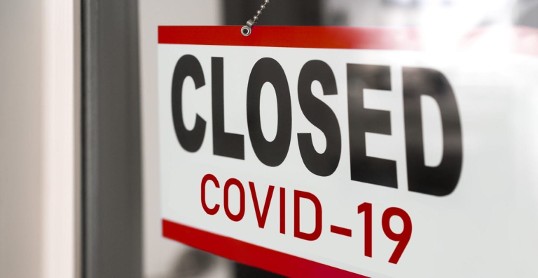
COVID Closed

Group offers proposal for liability protections

Essential businesses would be exempt from COVID-19 litigation.

By News Service Of Florida on September 24, 2020

Forty lobbyists and association representatives met over the summer to discuss ways to protect businesses from what some fear will be a flood of lawsuits related to COVID-19.

Co-chaired by Marc Salm, vice president of risk management at Publix Super Markets, and William Large, president of the Florida Justice Reform Institute, the group, dubbed the RESET Task Force, finalized a proposal that would exempt “essential businesses” from any COVID-19 related litigation and would change litigation rules for “non-essential businesses” that could be sued.

The task force is not proposing that the changes be applied retroactively to cover businesses. Essentially, the group is proposing that scores of businesses identified as “essential” in executive orders issued by Gov. Ron DeSantis be given immunity from COVID-19 related suits.

Those employers include hospitals, doctors’ officers, dentists’ offices, urgent care centers, clinics, rehabilitation facilities, nursing homes, assisted living facilities, child care facilities,  grocery stores, farmers’ markets, farm and produce stands, food banks, convenience stores, gas stations, auto-supply stores and banks.

For businesses that could still face lawsuits, the task force is recommending that the Legislature raise the bar for culpability in COVID-19 claims from simple negligence to gross negligence.

The task force also wants lawmakers to change  evidentiary standards for COVID-19 claims by upping it from a current “greater weight of the evidence” standard to  “clear and convincing evidence.”

Another recommendation is that the Legislature put into law for businesses a rebuttable presumption that people who interacted with the businesses were not infected with COVID-19. But the recommendation would allow that presumption to be overcome by clear and convincing evidence that the businesses had knowledge otherwise.

Breaking his silence on liability limitations amid the pandemic, DeSantis said Tuesday the Legislature could consider a bill to give liability protections to “run-of-the-mill businesses” during a Special Session that also could involve his controversial plan to crack down on disorderly protesters.

DeSantis unveiled the plan about protesters Monday and suggested Tuesday that a Special Session could be held when lawmakers return to Tallahassee for a Nov. 17 post-election organization Session.

“There is a lot of concern about liability,” DeSantis said. “I believe it holds the economy back.”

Members of the RESET Task Force include representatives of groups and companies such as the Florida Home Builders Association, the Florida Council of 100, Travelers Insurance, the Florida Trucking Association, the Florida Health Care Association,  the Florida Bankers Association, the Florida Retail Federation, Associated Industries of Florida, Florida Realtors and Walgreens.

https://floridapolitics.com/archives/369349-group-offers-proposal-for-liability-protections

https://www.fljustice.org/wp-content/uploads/2024/11/fjri-news.jpg 800 800 RAD Tech https://www.fljustice.org/wp-content/uploads/2024/11/Florida-Justice-Reform-Institute.jpg RAD Tech2020-09-24 15:52:062025-07-09 14:29:17Group offers proposal for liability protections
Florida Justice Reform Institute

Praise rolls in for Gov. Ron DeSantis’ Supreme Court picks

May 26, 2020/in Florida Politics


Fla Pol

Florida Supreme Court

Praise rolls in for Gov. Ron DeSantis’ Supreme Court picks

The son of Cuban immigrants and the first Caribbean American will join Florida’s Supreme Court.

By Jason Delgado on May 26, 2020

Reactions to Gov. Ron DeSantis’ two new picks for the Florida Supreme Court are pouring in from across the state.

On Tuesday, DeSantis announced the appointment of Judge Renatha Francis and South Florida lawyer John Couriel to the Supreme Court. The two were tapped from a pool of nine nominees.

Among the many who welcomed the appointments was John Stemberger, president of the Florida Family Policy Council.

“Judge Renatha Francis is a woman with an extraordinary life story, solid character and deep faith,” Stemberger said in a statement. “I know her personally and she is also clear on the limited and restrained role of the court and is a ‘textualist’ in the tradition of Clarence Thomas in her judicial philosophy. As the first Jamaican/Caribbean American Justice on the Florida Supreme Court, Francis is an experienced and brilliant choice for Florida’s future.”

Stemberger also lauded Couriel’s credentials.

Courie, a Harvard graduate and son of Cuban immigrants, will give up a lucrative partnership at the Kobre & Kim law firm for the role.

“Attorney John Couriel is a highly respected lawyer with stellar credentials and a conservative judicial philosophy,” Stemberger said. “When I served as a member of the Judicial Nominating Commission for eight years, we were always impressed when we found candidates who were not pursuing judicial positions motivated by an increase in salary.

The Florida Justice Reform Institute also praised the appointments. Led by President William Large, the institute is a lobbying group working on behalf of small businesses.

“The Florida Justice Reform Institute applauds Governor Ron DeSantis for this thoughtful and decisive leadership as he continues to reshape the Florida Supreme Court,” Large said in a statement. “The Governor’s appointments of John Couriel and Renatha Francis as the 90th and 91st Justices continue his mission to restore the court to its proper role as the interpreter of our laws, not the author.”

Several lawmakers and state leaders also took to Twitter to applaud the appointment.

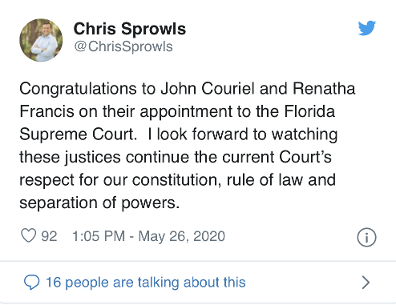
House Speaker-Designate Chris Sprowls of Clearwater congratulated the pair and said he looks forward to their addition on the high court.

“Congratulations to John Couriel and Renatha Francis on their appointment to the Florida Supreme Court,” Sprowls said. “I look forward to watching these justices continue the current Court’s respect for our constitution, rule of law and separation of powers.”

Chris Sprowls

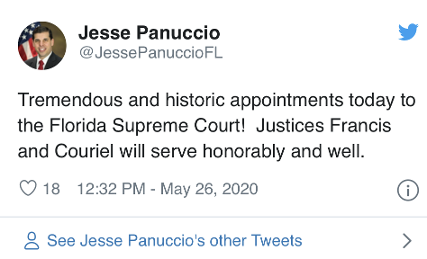
Jesse Panuccio, a former U.S. acting associate attorney general and former labor secretary of Florida, described the appointments as “historic.”

“Tremendous and historic appointments today to the Florida Supreme Court!  Justices Francis and Couriel will serve honorably and well.”

Panuccio tweet

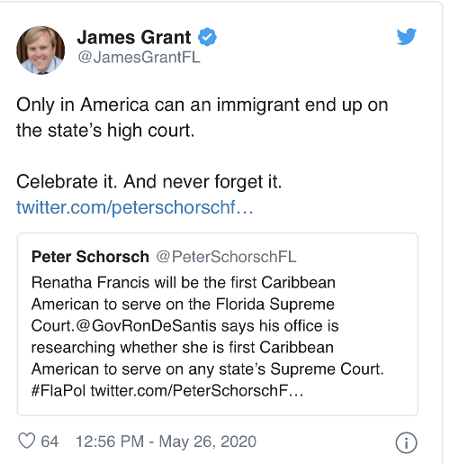
Rep. James Grant of Hillsborough called the Francis’ nomination worthy of celebration.

“Only in America can an immigrant end up on the state’s high court. Celebrate it. And never forget it,” tweeted Grant, a Republican

Grant tweet

Francis and Couriel’s appointments will settle the vacancies created by the departure of Justices Barbara Lagoa and Robert Luck to the 11th U.S. Circuit Court of Appeals late last year.

Francis, who is on maternity leave, will not be constitutionally qualified to take the bench until September when she will have officially served as a bar member for 10 years.

That raised questions among Adam Richardson, an appellate lawyer in West Palm Beach who has repeatedly doubted the legality of DeSantis’ appointment delay. He told The News Service of Florida he does not think the Governor is allowed to wait out Francis’ eligibility and noted that her appointment could be challenged if a citizen or taxpayer files a challenge directly to the Florida Supreme Court.

https://floridapolitics.com/archives/335607-praise-rolls-in-for-gov-ron-desantis-supreme-court-picks

https://www.fljustice.org/wp-content/uploads/2024/11/fjri-news.jpg 800 800 RAD Tech https://www.fljustice.org/wp-content/uploads/2024/11/Florida-Justice-Reform-Institute.jpg RAD Tech2020-05-26 15:58:382024-11-25 09:43:10Praise rolls in for Gov. Ron DeSantis’ Supreme Court picks
Florida Justice Reform Institute

Doctors seek protection from liability lawsuits as confirmed coronavirus cases increase

March 27, 2020/in Florida Politics

Fla Pol

Virus

Doctors seek protection from liability lawsuits as confirmed coronavirus cases increase
The worry stems from the Governor’s Executive Order suspending elective surgeries.

By Ryan Nicol on March 27, 2020

Some doctors are warning the Governor’s Executive Order suspending elective surgeries could cause confusion — and even lawsuits — as Florida continues to respond to the COVID-19 pandemic.

The Governor has said doctors are given some latitude to make the determination of what qualifies as essential or nonessential procedures. Several medical associations are warning that leaving the decision to doctors could open them up to liability.

Ronald F. Giffler, President of the Florida Medical Association, was one of several to call for increased clarity Thursday.

“We ask Gov. DeSantis to immediately consider these medical professional liability protections to allow health care providers to make the necessary decisions without fear of lawsuits as a result of those decisions, under Executive Order No. 20-72,” Giffler said.

The groups proposed some potential paths to protect doctors from liability. One is to issue an Executive Order making doctors “immune to civil liability for any injury or death alleged to have been sustained directly as a result of an act or omission by such health care provider.”

Another option would be to extend the principle of sovereign immunity to health care providers — establishing them as agents of the Department of Health. Sovereign immunity serves to protect government officials from lawsuits stemming from the routine carrying out of government functions.

“The Florida Osteopathic Medical Association (FOMA) joins other providers in seeking guidance under the executive order and believe these suggested solutions will allow physicians to provide much needed care for Florida patients,” added Eric A. Goldsmith, the group’s President.

DeSantis’ original executive order limited elective procedures in order to maintain stockpiles of medical materials needed to treat the increasing rise in confirmed COVID-19 cases.

William Large, President of the Florida Justice Reform Institute, also pushed the Governor to act further in light of doctors’ concerns.

“Gov. DeSantis’ bold leadership on this issue will require medical providers to make tough decisions,” Large said.

 “We’re all in this together, and medical providers’ first priority should be taking care of the sick, not worrying about being sued for trying to comply with a government order in a national emergency.”

https://floridapolitics.com/archives/325495-doctors-seek-protection-lawsuits-coronavirus

https://www.fljustice.org/wp-content/uploads/2024/11/fjri-news.jpg 800 800 RAD Tech https://www.fljustice.org/wp-content/uploads/2024/11/Florida-Justice-Reform-Institute.jpg RAD Tech2020-03-27 15:56:492025-07-10 14:29:53Doctors seek protection from liability lawsuits as confirmed coronavirus cases increase
Florida Justice Reform Institute

Bad faith about bad faith

February 12, 2020/in Florida Politics


Fla Pol

Sunburn

Sunburn — The morning read of what’s hot in Florida politics — 2.12.20

Bad faith about bad faith — Tuesday’s Senate Banking & Insurance Committee saw Sens. Brandes and Lee accuse each other of being disingenuous. Supposedly a deal had been worked out to add a negotiated bad faith reform provision to Lee’s auto PIP repeal bill, SB 378. When Brandes tried to put that same provision onto his omnibus insurance bill, SB 1334, Lee objected. Ultimately, seeing the votes would cancel each other out, both Senators chose to TP their bills and live to fight another day. Commenting on the bad faith language after the hearing, William Large, president of the Florida Justice Reform Institute, said, “The law currently requires a civil remedy notice for first parties before they sue for bad faith. The trial lawyers don’t object to that; why do they object to the same notice now for third parties?”

https://schorsch.cmail19.com/t/i-e-xwirky-trlttliyt-y/

https://www.fljustice.org/wp-content/uploads/2024/11/fjri-news.jpg 800 800 RAD Tech https://www.fljustice.org/wp-content/uploads/2024/11/Florida-Justice-Reform-Institute.jpg RAD Tech2020-02-12 15:56:152024-11-25 09:59:16Bad faith about bad faith
Florida Justice Reform Institute

House subcommittee OK’s PIP repeal legislation

February 4, 2020/in Florida Politics


Fla Pol

Car crash

House subcommittee OK’s PIP repeal legislation

Most of the opponents’ concerns centered on Florida’s bad faith laws.

By Sarah Mueller on February 4, 2020

Legislation sponsored by Rep. Erin Grall (HB 771) to repeal Personal Injury Protection faced a slew of opposition in the House Insurance and Banking Subcommittee Tuesday.

Most of the concerns centered on the state’s bad faith laws, which establishes an obligation on behalf of insurance companies to defend their policyholders against third-party lawsuits. Despite that, the bill easily passed the committee.

Grall’s bill would replace PIP no-fault vehicle insurance with bodily injury coverage. It would require drivers carry at least $25,000 in liability for the death or injury of one person in a crash and $50,000 for the injury or death of two or more people in a crash. It would retain the existing $10,000 coverage for property damage. The bill would also mandate insurance companies offer drivers $10,000 in medical payments unless consumers opt out in writing.

Grall argues that despite changes lawmakers passed in 2012 to PIP, premiums continue to rise.

“It is time that we make a policy decision that favors personal responsibility over that no-fault system,” she said.

Several subcommittee members voiced frustration with the PIP system. Democratic Rep. Al Jacquet said as a legislator and a defense attorney, he supported Grall’s legislation.

“I can’t help but think when we make sure that Floridians have a higher amount of coverage, we’re actually helping the costs go down,” Jacquet said.

But opponents were less optimistic about the potential results of Grall’s legislation. Insurance companies said they opposed the bill unless lawmakers also tackle changes to Florida’s bad faith law.

“Right now, a claimant can refuse to provide documents and ignore phone calls and emails, but then set arbitrary deadlines for a settlement,” said Kathy Maus, an attorney with Florida Justice Reform Institute. “They’re hoping the insurer misses the deadline, so they can sue the insurer for 100 times the policy limits or more.”

Grall argues that PIP lawsuits are already a major driver of litigation in the state. She said there were 60,000 lawsuits in 2017, up 20,000 from the previous year.

Opponents also took issue with the opt-out provision. They said that because it’s on the consumers to take action, most drivers will retain that coverage without realizing it’s optional. Some insurance companies said they fear premiums will rise.

Physician groups also opposed the legislation. Chris Nuland with the Florida Chapter of American College of Surgeons said the group is concerned health insurance premiums will go up, causing more Floridians to become uninsured. About 12% of state residents currently don’t have health insurance.

Senate Infrastructure and Security Committee Chairman Tom Lee is sponsoring a similar bill (SB 371). His legislation would require drivers opt-in for the medical payments, rather than opt-out as Grall’s bill does. Lee’s bill passed his committee and is waiting for action in the Senate Banking and Insurance Committee.

floridapolitics.com/archives/318096-house-subcommittee-oks-pip-repeal-legislation

https://www.fljustice.org/wp-content/uploads/2024/11/fjri-news.jpg 800 800 RAD Tech https://www.fljustice.org/wp-content/uploads/2024/11/Florida-Justice-Reform-Institute.jpg RAD Tech2020-02-04 15:57:562024-11-25 10:01:24House subcommittee OK’s PIP repeal legislation
Page 8 of 11«‹678910›»

FJRI News Categories

FJRI News Archive

Search Search
Florida Justice Reform Institute

Florida Justice Reform Institute

  • Phone

    (850) 222-0170

  • Hours of Operation

    Monday – Friday, 9 a.m.-5 p.m.

  • Location Location
    Address

    215 South Monroe Street
    Suite 140
    Tallahassee, FL 32301

Site Links

  • The Committee for Florida Justice Reform
  • About
  • Legislative
  • Appellate Work
  • FJRI in the News
  • Get Involved
© 2026 Florida Justice Reform Institute, All Rights Reserved. | Website Hosting & Web Development by RAD TECH
  • Link to Facebook
  • Link to X
  • Link to LinkedIn
Scroll to top Scroll to top Scroll to top